


Hiring breaks faster than any other process in a growing company – and we all know the cost (financial and emotional) that even a single bad hire can cause.
Which is why an applicant tracking system (ATS) is so important to implement early on. We ran hiring at Venture Harbour on Breezy for over five years and tested nine alternatives. Here’s what to look for when choosing one — and how the ten best stack up.
Short on time? Breezy is the best ATS for most small businesses — it’s what we ran our own hiring on for over five years, and its flat-rate pricing (free Bootstrap plan, then $157/mo on the annual Startup plan) means your whole team can collaborate on candidates without per-seat licences. Manatal is the budget AI pick at $15/user/mo, and Ashby is what I’d choose as a scaling, VC-backed startup. The full comparison below covers all ten.
What to look for in an ATS
There are five things that separate a good ATS from a mediocre one.
-
Pipeline management. A drag-and-drop board that moves candidates through stages you define. If this feels clunky, nothing else matters.
-
Automation depth. Stage-triggered actions — rejection emails, screening questionnaires, interview scheduling. These are the most mind-numbingly tedious jobs when you have 198 applications to wade through. Automate them.
-
Sourcing reach. You want one-click publishing to lots of job boards. Originally, I assumed that 99% of candidates will just use the big job boards (e.g. Indeed.com in the UK) but this misses some nuance – niche job boards often bring in very high-quality candidates.
-
Collaborative hiring with a paper trail. Shared scorecards, structured interview kits, decision logs. From a compliance perspective you’ll want to ensure you’ve got a paper trail for why each candidate was rejected or scored the way they were.
-
Pricing model. Flat-rate plans (Breezy, GoHire, Teamtailor) usually beat per-seat pricing for startups under 50 people. Per-seat only makes sense once you have a dedicated recruiting team.
Top Applicant Tracking Software
One important thing to note about ATS software is that you’re not limited to choosing from a small group of providers—there are lots of solutions to choose from, each with different feature sets, price points, and the niche it’s designed for. If you want to broaden your search beyond our picks, ATS Lab is a useful directory for comparing more applicant tracking tools side by side.
We’ve chosen some of our favourites for specific mention:
- Breezy - Best ATS for small businesses
- Ashby — Best all-in-one ATS for scaling startups
- Manatal — Best AI-powered ATS on a budget
- Workable - Best ATS with built-in sourcing tools
- Greenhouse - Best ATS for tech companies
- Teamtailor — Best for employer branding
- BambooHR - Best end-to-end HR solution for startups
- Lever — Best ATS + CRM combo
- Zoho Recruit — Best free ATS for startups
- GoHire - Best UK-based ATS for small teams
The Best Applicant Tracking Systems Compared
| Tool | Best for | Price from | Free plan? |
|---|---|---|---|
| Breezy | Small businesses | $157/mo (Startup, annual) | Yes — 1 active position |
| Ashby | Scaling startups | $400/mo (Foundations) | No |
| Manatal | AI on a budget | $15/user/mo (annual) | 14-day trial |
| Workable | Built-in sourcing (400M+ database) | $299/mo (Standard) | No |
| Greenhouse | Tech companies | ~$6,000/yr (Core) | No |
| Teamtailor | Employer branding | Quote-based (~$229–400/mo typical) | No |
| BambooHR | End-to-end HR for startups | $250/mo minimum (≤25 employees) | No |
| Lever | ATS + CRM combo | Quote-based (~$4–8K/yr) | No |
| Zoho Recruit | Free ATS | Free; $25/user/mo (Standard, annual) | Yes — 1 active job |
| GoHire | UK-based small teams | $99/mo (Starter) | 14-day trial |
Prices verified April 2026. Now, let’s dive into the full list of the best applicant tracking systems.
01Breezy
Best ATS for small businesses (this is the tool we actually use)
Breezy HR is our top pick — and not just because we’ve used it ourselves at Venture Harbour for over five years. It’s the ATS that consistently delivers the best balance of power, simplicity, and value for growing businesses.
What makes Breezy click for us is how familiar it feels from day one. The interface mirrors a Kanban board (think Trello), where you define clear stages in your hiring process and drag candidates through them. There’s no steep learning curve, no week-long onboarding — you can have your first job posted within minutes.

Where Breezy really earns its keep is through “stage actions” — automated triggers that fire when you move a candidate from one stage to the next. For instance, when someone applies for a role at Venture Harbour, we automatically send a screening questionnaire. This alone filters out roughly 15–20% of candidates who aren’t a good fit, saving our team hours of manual review every week.
Breezy has also stepped up its AI game. The platform now includes AI-powered candidate evaluation, interaction summaries, and resume auditing — features that help you quickly surface the strongest candidates without wading through every application manually. It also includes built-in video interviewing (both live and one-way), self-scheduling for candidates, and EEOC/OFCCP compliance tracking that works with a simple toggle.

One criticism we’d flag: some of the more advanced features, like creating custom interview guides and multi-path questionnaires, aren’t immediately intuitive. There’s a bit of a learning curve once you move beyond the basics. And the mobile app, while functional, doesn’t surface all the information you’d see on desktop.
Key features:
- Unlimited users and candidates on all plans (no per-seat charges)
- Visual drag-and-drop hiring pipeline with customisable stages
- AI-powered candidate scoring and resume auditing
- Automated stage actions (emails, questionnaires, tasks triggered on candidate movement)
- Built-in video interviewing (live and one-way)
- Candidate self-scheduling synced with Google/Office 365 calendars
- One-click distribution to 50+ job boards
- GDPR compliance and EEOC/OFCCP reporting

Pricing:
Breezy doesn’t charge per seat — all plans include unlimited users and candidates, which is a genuine advantage over competitors.
| Plan | Monthly | Annual (per month) | Active Positions |
|---|---|---|---|
| Bootstrap (Free) | $0 | $0 | 1 |
| Startup | $189/mo | $157/mo | Unlimited |
| Growth | $329/mo | $273/mo | Unlimited |
| Business | $529/mo | $439/mo | Unlimited |
| Pro | Custom | Custom | Unlimited |
Annual billing includes 2 months free. The Pro tier adds API access, SSO, advanced reporting, and a dedicated account manager — contact Breezy for a quote.
-
Genuinely intuitive interface with minimal onboarding needed
-
No per-seat pricing — great value for collaborative hiring teams
-
Strong automation that meaningfully reduces manual work
-
Free tier available to test before committing
-
Advanced features (interview guides, reporting) have a learning curve
-
Mobile app lacks some desktop functionality
-
Some users report occasional integration inconsistencies with Google Workspace
-
Limited language support compared to enterprise-grade alternatives
Our verdict: Breezy is the ATS we’d recommend to most startups and small businesses. It does the fundamentals exceptionally well, the pricing is fair, and the automation genuinely saves time. If you need enterprise-grade compliance or deep analytics, you’ll outgrow it — but for the majority of growing companies, it’s hard to beat.
Is Breezy the right ATS for you?
Startups and small businesses (5–200 employees) that want a powerful ATS without per-seat charges. If you’re hiring across multiple roles, want collaborative scoring, and need automation that actually fires reliably, Breezy is the safest pick on this list.
Enterprise teams that need deep compliance, advanced analytics, or sophisticated multi-region workflows. If your hiring stack already includes Workday or SAP SuccessFactors, Breezy will feel underpowered. Look at Greenhouse or Ashby instead.
02Ashby
Best all-in-one ATS for scaling startups and data-driven hiring teams.
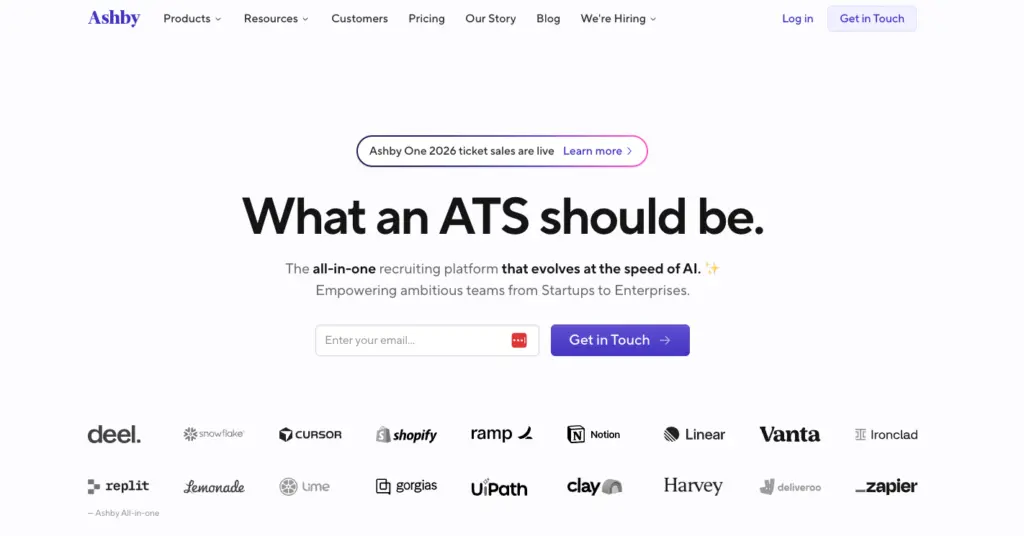
Ashby has rapidly become the ATS of choice for ambitious, fast-growing tech companies — and for good reason. It’s one of the few platforms that genuinely combines ATS, CRM, scheduling, and deep analytics into a single product without feeling bolted together.
The standout feature is Ashby’s analytics. Where most ATS platforms give you basic time-to-hire reports, Ashby provides granular data on pass-through rates by stage, interviewer calibration, source effectiveness, and pipeline health — the kind of metrics that a Head of Talent at a Series B startup actually needs to make hiring decisions. If you’re the type of team that wants to measure everything, Ashby delivers.
The automation is equally impressive. You can set up multi-step workflows that trigger based on candidate stage changes, automate interview scheduling across complex panels, and create structured interview kits with standardised scorecards. It’s clearly designed by people who’ve felt the pain of hiring at scale.
That said, Ashby isn’t simple. The platform requires genuine investment to set up properly — we’re talking weeks of configuration, not hours. The scheduling system alone has 14 tabs of settings. For a 5-person startup making its first few hires, this is overkill. Ashby is built for teams that are hiring consistently and have someone dedicated to managing the recruitment process.
Key features:
- All-in-one ATS + CRM + scheduling + analytics
- Industry-leading hiring analytics with custom dashboards
- Structured interview kits with standardised scorecards
- Multi-step workflow automation
- AI-powered candidate sourcing and outreach
- Candidate relationship management for passive talent pools
- Integrations with 100+ HR tools
Pricing:
Ashby finally published headline pricing for its smallest tier in 2025 — though Plus and Enterprise remain quote-only.
| Plan | Price | Best For |
|---|---|---|
| Foundations (All-in-One) | $400/mo | Up to 100 employees |
| Plus (All-in-One) | Custom quote | 101–1,000 employees |
| Enterprise (All-in-One) | Custom quote | 1,000+ employees |
| Ashby Analytics (add-on) | Custom quote | Layered onto an existing ATS |
Annual contracts unlock a 10% discount. Multi-year deals can stretch this to 20%. There’s no public free trial — you’ll need to book a demo to evaluate the platform.
-
Best-in-class analytics and reporting — genuinely actionable data
-
True all-in-one platform (ATS, CRM, scheduling, analytics)
-
Powerful automation that scales with your hiring volume
-
Strong reputation among tech startups and VC-backed companies
-
Steep learning curve — requires weeks of onboarding and configuration
-
No free tier or trial; annual contracts are typical
-
English-only interface (no multi-language support as of 2026)
-
Sourcing tools have email lookup caps that can bottleneck high-volume outreach
-
Advanced analytics requires a separate paid module
Our verdict: Ashby is the right choice if you’re a scaling startup with dedicated recruiting capacity and a hunger for data-driven hiring. It’s not the right tool for a founder doing occasional hiring — you’ll spend more time configuring it than actually recruiting. But for teams making 20+ hires per year, it’s one of the most powerful platforms available.
Is Ashby the right ATS for you?
Series A–C tech startups, mid-market companies hiring 20+ roles per year, and any team that takes hiring metrics seriously. The analytics, scheduling, and workflow automation pay off heavily once you have someone whose job it is to actually use them.
Open Ashby's WebsiteFounders making occasional hires, agencies managing many clients, or any team that wants to be live within the week. The configuration overhead is real — Ashby rewards committed users and punishes occasional ones.
03Manatal
Best AI-powered ATS for teams on a tight budget.
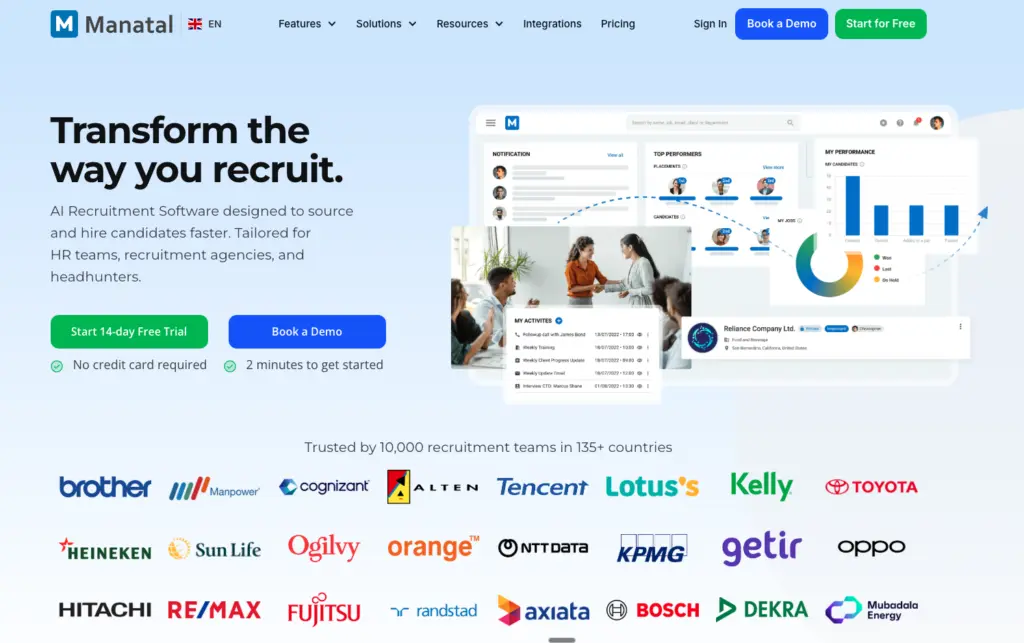
If you’re looking for genuine AI features at a price point that won’t make your accountant flinch, Manatal is difficult to ignore. Starting at just $15 per user per month (billed annually), it’s one of the most affordable ATS platforms on the market — yet it packs in AI-driven candidate scoring, social media profile enrichment, and access to a database of over 600 million candidates.
Founded in Bangkok in 2017, Manatal has grown rapidly by targeting the gap between expensive enterprise tools and bare-bones free options. The platform uses AI to automatically score and rank candidates against your job requirements, pulling in data from LinkedIn and 20+ social platforms to build richer candidate profiles than what you’d get from a CV alone.
The Kanban pipeline is clean and intuitive — you can drag candidates between stages, set up automated actions, and collaborate with your team through shared notes and activity feeds. Manatal also recently introduced an AI Interviewer feature, which conducts automated first-round screening with asynchronous video interviews and AI-generated assessment summaries. It’s a genuinely useful feature for high-volume roles where you’d otherwise spend days on initial phone screens.
The trade-off for the low price is depth. Reporting is basic compared to tools like Ashby or Greenhouse, customisation options are limited, and the integration ecosystem is narrower than what you’ll find with more established platforms. The career page builder works but feels like an afterthought rather than a standout feature.
Key features:
- AI-powered candidate scoring and ranking
- Social media enrichment across 20+ platforms (LinkedIn, Facebook, etc.)
- Access to a Sourcing Hub of 600M+ candidate profiles
- AI Interviewer for automated first-round screening
- Job posting to 2,500+ free and premium channels
- Customisable Kanban pipeline
- Recruitment CRM for agencies
- GDPR, CCPA, and PDPA compliance
Pricing:
Manatal’s pricing is refreshingly transparent — no need to speak with sales:
| Plan | Annual (per user/mo) | Monthly | Limits |
|---|---|---|---|
| Professional | $15 | $19 | 15 jobs · 10,000 candidates |
| Enterprise | $35 | $39 | Unlimited jobs & candidates · workflow automations |
| Enterprise Plus | $55 | $59 | + SSO, user groups, API access, priority support |
| Custom | On request | On request | Dedicated AM, custom features, phone support |
All plans include a 14-day free trial with no credit card required. Hiring managers are unlimited on every tier — you only pay per recruiter seat.
-
Exceptional value — hard to find this level of AI functionality at this price
-
Fast setup (the company claims 15 minutes, which in our experience isn’t far off)
-
Transparent pricing with no hidden fees
-
Strong AI features including the new AI Interviewer
-
Reporting and analytics are basic — not suitable for data-driven hiring teams
-
Limited customisation of workflows and dashboards
-
Smaller integration ecosystem than competitors
-
No free tier (only a 14-day trial)
-
Career page builder is functional but underwhelming
Our verdict: Manatal is the best “bang for your buck” ATS on the market right now. If you’re a startup or small business that wants AI-powered recruiting without spending £300+/mo, it’s a no-brainer to at least trial it. Don’t expect enterprise-grade analytics or deep customisation — but for straightforward hiring with smart automation, it punches well above its price point.
Is Manatal the right ATS for you?
Cost-conscious startups, recruitment agencies running multiple client searches, and any team that wants AI features without the enterprise price tag. The agency CRM is genuinely useful — Manatal is one of the few platforms that caters to both in-house teams and external recruiters.
Open Manatal's WebsiteCompanies that need polished employer branding (the career page builder is the weakest part of the product), heavy custom reporting, or deep integrations with HRIS systems. If reporting depth is critical, look at Ashby instead.
04Workable
Best ATS with built-in sourcing tools.
Boasting, “Enterprise-grade hiring, for everyone,” Workable offers a robust solution in a pretty low-cost package and with flexible options for scaling up your recruiting efforts.
They break down their features into 3 main categories:
- Find
- Evaluate
- Automate
Their platform offers many of the features you’d expect, allowing you to build branded career portals and job listings, sync with job boards, and share listings via social media.

But, what makes Workable really stand out is their built-in database of over 400 million candidates, which is searchable by employment history, roles, and specific skills.

This gives your team the ability to proactively source candidates and build automated outreach campaigns to drive applications. Workable also makes AI-powered candidate recommendations based on your job listings. Note: Access to the candidate database appears to only be available for annual plans and not pay-as-you-go solutions.
In addition to these powerful tools, Workable has built-in features to drive internal referrals, including gamification, rewards, and leaderboards.
They have collaborative evaluation tools so your hiring team can score and discuss specific candidates.

And, one more unique feature, is what Workable calls “one-way video interviews”, which allow candidates to record video responses to specific prompts. They bill these as a replacement for a traditional phone screen. These require integration with third-party video tools.

Workable gets rave reviews for the ability to quickly build and deploy hiring workflows, including automation for candidates at various stages in the hiring process.
All told, Workable offers a pretty unique platform that offers features beyond many ATS solutions. Perhaps the only drawback is that they are only focused on sourcing and hiring, but don’t offer the same onboarding and employee management features of an HR suite like Greenhouse or BambooHR.
Key features:
- Branded careers and job listings pages
- Searchable database of 400 million+ candidates
- Gamified internal referral features
- One-way video interviews
- Multi-step workflow automation
- Built-in HRIS, onboarding, time tracking, and performance reviews on Premier+
-
400M+ candidate database is genuinely searchable by skill, role, and company — closest thing to a built-in LinkedIn Recruiter
-
15-day free trial includes the full Standard feature set (no credit card required)
-
All-in-one Recruiting + HR if you upgrade to Premier
-
Strong automation for sourcing campaigns and referral programmes
-
Mature integration ecosystem (300+ integrations)
-
Standard plan now starts at $299/mo — pricier than Breezy or GoHire and the gap has widened in 2025–26
-
Texting, video interviews, and assessments are paid add-ons on Standard ($59–$109/mo each)
-
Pure ATS focus on Standard — onboarding and HR features only land on Premier
-
Pay-as-you-go pricing was retired; you now commit to a plan tier
Pricing:
Workable retired its pay-as-you-go option in 2024. All plans are now monthly or annual subscriptions, and prices below assume up to 20 employees with 20% off on annual billing.
| Plan | Monthly | Annual | Best For |
|---|---|---|---|
| Standard | $299/mo | $3,588/yr | Pure ATS for small teams |
| Premier | $599/mo | $7,188/yr | Full Recruiting + HR suite |
| Enterprise | $719/mo | $8,628/yr | Larger teams needing SSO, advanced security |
Standard add-ons (per month): Texting+ $89 · Video Interviews+ $109 · Assessments+ $59 · Performance Reviews+ $39. Premier and Enterprise bundle these in.
Is Workable the right ATS for you?
Mid-sized companies (20–500 employees) that want recruiting plus light HRIS in one platform, and any team that does heavy proactive sourcing. The 400M+ candidate database is the genuine differentiator — if you’re hiring for hard-to-fill roles, Workable saves you a separate LinkedIn Recruiter subscription.
Open Workable's WebsiteBootstrapped startups and tiny teams. At $299/mo Standard, Workable is meaningfully more expensive than Breezy ($157/mo) or GoHire ($99/mo) for similar core ATS functionality. Pay only when you genuinely need the candidate database or HR features.
05Greenhouse
Best ATS for tech companies.
The goal of this ATS is twofold—allow you to scale your recruitment processes during times of growth, and empower you to refine them during off-peak times.
Greenhouse has quickly become a recruitment and hiring platform du jour for tech companies and startups. In part, because it offers all of the core features you’ll need to rapidly scale your team in a well-designed and intuitive package. But, it’s also especially well-suited for industries that prioritise candidate experience and compete to hire top talent.

SoftwareAdvice.com
The UI and UX for both applicants and internal teams are truly second to none.

GetApp.com
Greenhouse also offers best-in-class features for creating and managing diversity, equity, and inclusion (DE&I) initiatives. They offer specific tools designed to combat hiring bias like in-app prompts for hiring teams, anonymous candidate reviews, and pre-defined decision criteria.
Key features:
- Best-in-class user interface and candidate experience scores
- Structured interview kits with standardised scorecards
- Sourcing & CRM with Real Talent matching
- DE&I tools (anonymous reviews, in-app bias prompts)
- 500+ pre-built integrations (the largest ATS marketplace)
- SOC 2, GDPR, and enterprise-grade audit logs (Pro tier)
- Onboarding workflows with personalised welcome sequences
-
Reference standard for structured hiring — interview kits and scorecards genuinely reduce hiring bias
-
Largest integration marketplace of any ATS (500+ partners)
-
Excellent candidate experience scores on G2 and Capterra
-
Strong DE&I tooling, including anonymised candidate reviews
-
Native onboarding handoff if you also use Greenhouse Onboarding
-
Eye-watering price for early-stage companies — Core typically starts around $6,000/yr at the smallest tier and climbs aggressively from there
-
Implementation can run $2,000–$8,000 on top of subscription fees
-
Plans renamed to Core / Plus / Pro in 2025 — older articles still reference Essential / Advanced / Expert
-
Per-employee scaling means costs balloon as headcount grows, even if hiring volume stays flat
-
Annual contracts only; expect 3–8% renewal escalators
Pricing:
Greenhouse doesn’t publish list pricing. Plans are now branded Core / Plus / Pro (renamed from Essential / Advanced / Expert in 2025). Based on verified buyer reports through early 2026:
| Company Size | Approx. Annual Cost (Core) |
|---|---|
| Under 50 employees | $6,000–$10,000/yr |
| 50–200 employees | $12,000–$18,000/yr |
| 200–500 employees | $25,000–$40,000/yr |
| 1,000+ employees | $50,000–$70,000+ /yr (Pro) |
Implementation is quoted separately at smaller tiers ($2,000–$8,000). Pro adds enterprise security, audit logs, developer sandbox, and unlimited CRM events.
Is Greenhouse the right ATS for you?
Series B+ tech companies, scale-ups hiring 50+ roles per year, and any team that takes structured hiring seriously. If you need a defensible interview process, deep integrations, and enterprise-grade security, Greenhouse is the safe procurement-friendly choice.
Open Greenhouse's WebsiteStartups under 50 employees, bootstrapped teams, and anyone with a budget under $500/mo. You’re paying enterprise prices regardless of how few hires you make. Ashby is a stronger choice for the same money at scaling-startup stage; Breezy or Workable will save you thousands at small-business stage.
06Teamtailor
Best ATS for employer branding and candidate experience.
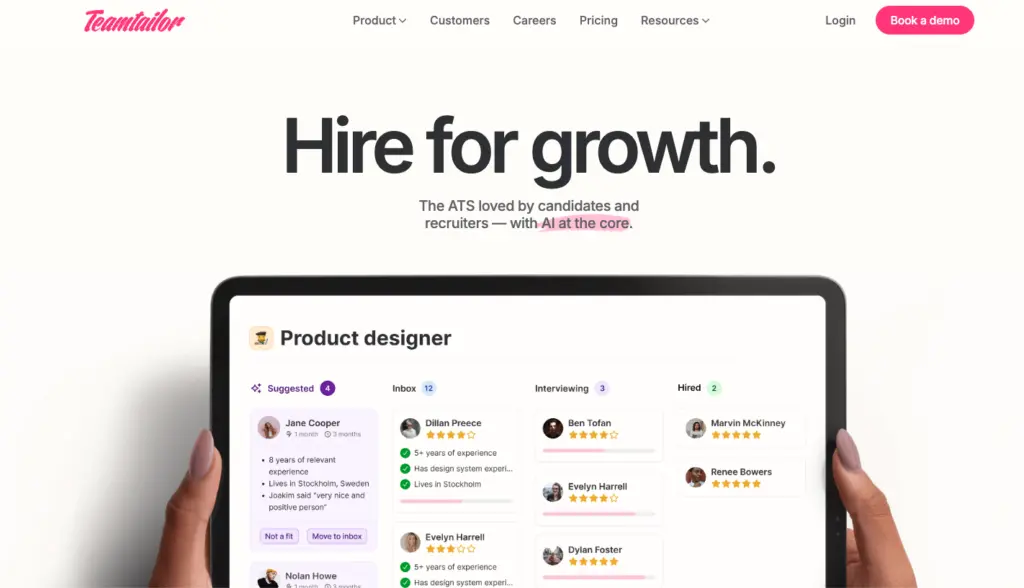
Teamtailor approaches recruitment from a different angle than most ATS platforms. Rather than focusing primarily on pipeline management or analytics, it treats hiring as a marketing and branding exercise — and that philosophy shapes every aspect of the product.
The centrepiece is Teamtailor’s career site builder, which is genuinely best-in-class. It’s a no-code, drag-and-drop editor that lets your talent team (not your developers) create polished career pages with team stories, culture videos, department spotlights, and interactive content. The level of customisation is remarkable — you can adjust fonts, colours, button styles, and layouts without touching a line of code. For companies competing for talent in crowded markets, this feature alone can justify the subscription.
Beyond branding, Teamtailor is a capable ATS with strong automation. You can set up triggers to automatically move candidates between stages, send templated communications, and schedule interviews. The AI Co-pilot — introduced in recent updates — helps draft job descriptions, summarise CVs, and suggest candidate matches, though it’s more of a time-saver than a game-changer at this stage.
Teamtailor is particularly popular in Europe (it was founded in Sweden) and includes solid GDPR compliance features out of the box. It’s priced competitively for what it offers, though you’ll need to speak with sales for an exact quote.
Key features:
- Best-in-class no-code career site builder
- AI Co-pilot for job descriptions, CV summaries, and candidate matching
- Automation triggers for pipeline stages and candidate communications
- DEI features including anonymised screening
- Employee referral tools
- Built-in analytics and hiring metrics
- GDPR compliance and multi-language support
- Unlimited users on all plans
Pricing:
Teamtailor doesn’t publish fixed pricing — you’ll need to book a demo. Unusually, it prices by the number of open job slots rather than headcount or seats, which makes the maths look very different from competitors. Verified buyer data through early 2026 puts the typical contracts at:
| Company Size | Approx. Annual Cost |
|---|---|
| Small team (1–5 active jobs) | ~$2,750–$5,000/yr |
| Growing team (10–20 active jobs) | $7,000–$17,000/yr |
| Mid-market (30+ active jobs) | $18,000–$36,000/yr |
| Enterprise (1,000+ employees) | Up to $72,000+ /yr |
12-month minimum contract is standard. Most agreements include 3–8% annual renewal escalators — worth negotiating out where possible. Unlimited users on every tier.
-
Best career site builder of any ATS — a genuine competitive advantage
-
Strong employer branding tools that attract higher-quality candidates
-
Unlimited users included (no per-seat charges)
-
Responsive customer support with live chat
-
Clean, modern interface that both recruiters and candidates enjoy
-
No monthly billing option — 12-month minimum contract
-
Pricing requires speaking with sales (no self-serve purchasing)
-
Reporting lacks depth for data-heavy teams
-
LinkedIn sourcing extension is limited compared to dedicated sourcing tools
-
Can feel too lightweight for complex, high-volume hiring operations
Our verdict: If employer branding is a strategic priority for your company, Teamtailor is the clear winner. The career site builder genuinely differentiates it from everything else on this list. As a pure ATS for processing candidates, it’s competent but not class-leading — so weigh up whether branding or pipeline power matters more for your team.
Is Teamtailor the right ATS for you?
European companies that compete for talent on culture and brand — agencies, design studios, consumer brands, and any team where the careers page is part of the marketing surface. Also a strong pick for companies with stable, moderate hiring volumes where job-slot pricing works in your favour.
Open Teamtailor's WebsiteFast-scaling startups (job-slot pricing punishes you when openings spike), procurement teams that need transparent published pricing, and high-volume recruiting teams that need analytics depth. Greenhouse or Ashby will serve you better.
07BambooHR
Best end-to-end HR solution for startups.
One more applicant tracking system that’s near and dear to our hearts is BambooHR.
For startups and small businesses that are looking to really button up their hiring and onboarding process—perhaps in one fell swoop—BambooHR is likely to check all of the boxes for your team.
The functionality extends beyond the common ATS and borders on an all-in-one HR suite, but in a much more accessible package (and price range) than many of the enterprise solutions out there.
On the hiring front, BambooHR offers a strong set of tools to build branded job pages, create listings, collect applications, and then build a candidate funnel to fill each role.

The features here are roughly equivalent to what you’ll get with solutions like Breezy or GoHire. But, Bamboo does offer some extended functionality that dips into the realm of employee experience, HR, and performance management.
This platform covers the most obvious next step in the hiring journey—employee onboarding.
From sending and storing offer letters to building customizing onboarding workflows, BambooHR packs a powerful suite of tools that can help you not just find and hire talent but bring them into the fold with less stress and headache.

This is important for startups because establishing a consistent onboarding flow is just as important as filling empty seats. And when you’re growing fast, you need a system in place to make sure that each new hire is ready to go right away.
BambooHR extends even further, offering time tracking, paid time off, benefits administration tools, employee satisfaction surveys, and more.
It’s the Swiss Army knife of hiring and managing employees.
One thing to consider here is that, in some cases, when platforms attempt to do it all, it comes at the expense of doing any one function particularly well. For what it’s worth, BambooHR boasts an average review of 4.5/5 on Capterra and they have hundreds of glowing reviews. But, some users have noted that the nitty-gritty HR features like benefits management are not as intuitive as you might expect.
Key features:
- Branded jobs pages and listings
- Candidate funnels and applicant tracking (5–50 active jobs by tier)
- Automated employee onboarding
- Employee records, benefits administration, time tracking
- Performance management tools and employee satisfaction surveys
- Native payroll (US) and integrations with major payroll providers
-
True end-to-end HR + ATS in a single platform — replaces three or four separate tools for most small businesses
-
Excellent onboarding workflows that hand off cleanly from the ATS
-
4.5/5 average review on Capterra with thousands of reviews
-
Native US payroll available as a paid add-on
-
Strong mobile app (one of the few HRIS platforms with feature parity to desktop)
-
ATS depth is fine for fewer than 20 hires/year — bigger hiring teams will outgrow it
-
No public pricing; everything requires a sales conversation
-
Per-employee pricing makes the bill scale with company size, not hiring volume
-
Some users report benefits administration is less intuitive than expected
-
Active job caps (5 on Core, scaling up by tier) can bottleneck rapidly hiring teams
Pricing:
BambooHR does not list public pricing — every quote is custom. Based on third-party buyer data through early 2026:
| Plan | Approx. Per-Employee Cost (mo) | What’s Included |
|---|---|---|
| Core | ~$10/employee | HRIS, employee records, time-off, basic ATS (5 active jobs) |
| Pro | ~$17/employee | + Performance management, advanced reporting, ATS (20 active jobs) |
| Elite | ~$25/employee | + Multi-EIN, advanced security, ATS (50 active jobs) |
Companies with 25 or fewer employees pay a flat $250/mo minimum. Per-employee rates decrease at higher headcount tiers. ATS is included in every plan — there’s no separate add-on fee.
Is BambooHR the right ATS for you?
Small businesses (10–200 employees) that want to consolidate HR, payroll, and recruiting into a single platform. If you’re hiring fewer than 20 roles per year and care more about onboarding and employee management than recruiting depth, BambooHR is the obvious all-in-one pick.
Open BambooHR's WebsiteHigh-volume recruiting teams, in-house recruiters making 50+ hires per year, and any company that doesn’t need a full HRIS. The ATS alone is overpriced compared to dedicated tools (Breezy, GoHire) — only buy BambooHR if you actually need the HR side.
08Lever (by Employ)
Best ATS + CRM combination for proactive talent sourcing.
Lever — now part of the Employ suite following its acquisition — was one of the first platforms to combine applicant tracking with a full candidate relationship management (CRM) system. This makes it particularly strong for companies that do a lot of proactive sourcing rather than simply posting jobs and waiting for applications.
The CRM functionality allows your team to build long-term talent pools, nurture passive candidates with automated email sequences, and track candidate engagement over time. When a role opens up, you can search your existing talent pool first rather than starting from scratch. For companies in competitive talent markets where the best candidates aren’t actively job-seeking, this is a genuine strategic advantage.
On the ATS side, Lever offers customisable hiring pipelines, collaborative feedback tools, interview scheduling, and offer management. The interface is clean and well-designed, though power users sometimes find it less configurable than alternatives like Greenhouse or Ashby.
Since joining Employ, Lever has been bundled with other recruitment tools in the portfolio, which can make the product positioning and pricing slightly confusing. The platform has also seen less frequent standalone updates compared to independent competitors.
Key features:
- Combined ATS + CRM in a single platform
- Talent nurture campaigns with automated email sequences
- Searchable talent pools for proactive sourcing
- Customisable hiring pipelines and workflows
- Collaborative candidate evaluation with structured feedback
- Diversity and inclusion analytics
- Advanced reporting and analytics
- 300+ integrations
Pricing:
Lever uses a custom, quote-based model — every price is negotiated. Based on verified buyer reports through early 2026:
| Company Size | Approx. Annual Cost |
|---|---|
| Small team (under 50 employees) | $4,000–$8,000/yr |
| Mid-market (50–500 employees) | $12,000–$37,000/yr |
| Enterprise (500–1,000+ employees) | $63,000–$144,000+ /yr |
A rough per-employee benchmark is $6–$8/employee/month. Annual contracts are standard. Add-ons (Candidate Insights, AI Screening by VONQ, Onboarding) cost extra.
-
Best-in-class CRM for building and nurturing passive talent pools
-
Strong combination of reactive (ATS) and proactive (CRM) hiring
-
Good analytics with diversity and pipeline health reporting
-
Established platform with a large integration ecosystem
-
Pricing isn’t transparent — requires sales conversations
-
The Employ acquisition has added some product positioning confusion
-
Can be expensive for early-stage startups
-
Feature development pace has arguably slowed since the acquisition
-
Not as strong on pure ATS workflow customisation as Greenhouse or Ashby
Our verdict: Lever is the right choice for companies that rely heavily on proactive sourcing and candidate relationship building. The CRM is genuinely differentiated — if you regularly nurture passive candidates over weeks or months before they’re ready to apply, Lever makes this workflow seamless. For companies that primarily hire through job postings, a traditional ATS will serve you just as well at a lower price.
Is Lever the right ATS for you?
Mid-market and enterprise companies that hire in competitive talent markets and rely on proactive sourcing. If your recruiting team builds and nurtures talent pools over months — common in tech, finance, and exec search — Lever’s combined ATS + CRM is the cleanest implementation available.
Open Lever (by Employ)'s WebsiteReactive hiring teams that mostly post jobs and wait for applications, startups under 50 employees, and any company that wants transparent pricing. Manatal includes CRM functionality at a fraction of the cost; Greenhouse offers stronger pure ATS capabilities at similar price points.
09Zoho Recruit
Best free ATS for bootstrapped startups and small teams.
If you’re a bootstrapped startup with no recruitment budget, Zoho Recruit is the strongest free ATS available. The Forever Free plan includes one active job, candidate management, email integration, and interview scheduling — enough to manage basic hiring without spending a penny.
Beyond the free tier, Zoho Recruit offers a solid feature set that punches above its weight class. The AI matching engine scores candidates against your job requirements, automated resume parsing builds structured profiles, and the platform integrates natively with the broader Zoho ecosystem (CRM, People, Mail, etc.) — a significant advantage if your business already uses Zoho tools.
For recruitment agencies, Zoho Recruit includes a full CRM module for managing client relationships alongside candidate tracking, making it one of the few platforms on this list that caters to both in-house hiring teams and agencies.
The trade-offs are predictable for a budget tool. The interface feels dated compared to modern competitors like Breezy or Teamtailor, the learning curve is steeper than it should be (especially initial setup), and customer support response times can be slow on lower-tier plans.
Key features:
- Forever Free plan with 1 active job
- AI candidate matching and scoring
- Automated resume parsing
- Job posting to major boards (Indeed, LinkedIn, Glassdoor, etc.)
- Built-in recruitment CRM for agencies
- Native integration with Zoho ecosystem
- Custom workflows and automation (on paid plans)
- GDPR and EEOC compliance tools
Pricing:
| Plan | Annual (per user/mo) | Monthly | Active Jobs |
|---|---|---|---|
| Forever Free | $0 | $0 | 1 |
| Standard | $25 | $30 | 10 (resume parsing, email templates) |
| Professional | $50 | $60 | Unlimited (AI matching, candidate portal) |
| Enterprise | $75 | $90 | Unlimited (custom modules, advanced analytics) |
Annual billing saves up to 16%. Add-ons (Vendor Portal, Video Interviews, Employee Licences) are priced separately and can push real-world costs 30–50% above the headline rate. Note: prices reflect the Staffing Agency edition — the Corporate HR edition skips the Professional tier and goes straight from Standard to Enterprise.
-
Genuine free tier with no time limit — rare among ATS platforms
-
Excellent value across all pricing tiers
-
Strong AI features for the price point
-
Native Zoho ecosystem integration
-
Dual-purpose: works for both in-house teams and recruitment agencies
-
Interface feels dated and less intuitive than modern competitors
-
Steeper learning curve, especially during initial setup
-
Customer support can be slow on lower-tier plans
-
Career page builder is basic
-
Requires a matching domain and email for job posting, which adds complexity
Our verdict: Zoho Recruit is the obvious choice for startups with zero recruitment budget. The free tier is genuinely usable (not just a demo), and the paid plans offer strong value. If your company already uses the Zoho ecosystem, it’s practically a no-brainer. The main risk is the dated interface — if candidate experience and employer branding matter to you, consider Teamtailor or Breezy instead.
Is Zoho Recruit the right ATS for you?
Bootstrapped startups, sole-trader recruitment agencies, and any business that already runs on the Zoho stack (CRM, Mail, People). The free tier is one of the only “actually usable” free ATS plans on the market — and the Staffing Agency edition is purpose-built for boutique recruiters.
Open Zoho Recruit's WebsiteCompanies that need polished employer branding, modern UX, or fast support response. The interface betrays the platform’s age and the support quality on lower tiers can be sluggish. If candidate experience matters, look at Breezy or Teamtailor.
10GoHire
Best ATS for UK-based companies
GoHire finds a sweet spot in the ATS space by offering the most popular features of other tools at a very competitive price point.
At Venture Harbour, we’ve considered making the jump to GoHire because it’s such a powerful tool in an easy-to-use package. It offers much of the same functionality as our current solution.
GoHire allows you to build a branded careers page and post job descriptions to your company socials as well as 15+ third-party job boards.

That’s, of course, a relatively small number of job board integrations compared to some other ATS options. But, it’s indicative of GoHire’s focus on startups and special emphasis on hiring for software companies.
GoHire offers a familiar, multi-step hiring workflow with defined stages and a snapshot of all candidates at each stage. It’s a bit more complex than the simplified view in a solution like Breezy, but also allows your team to rate and score candidates.
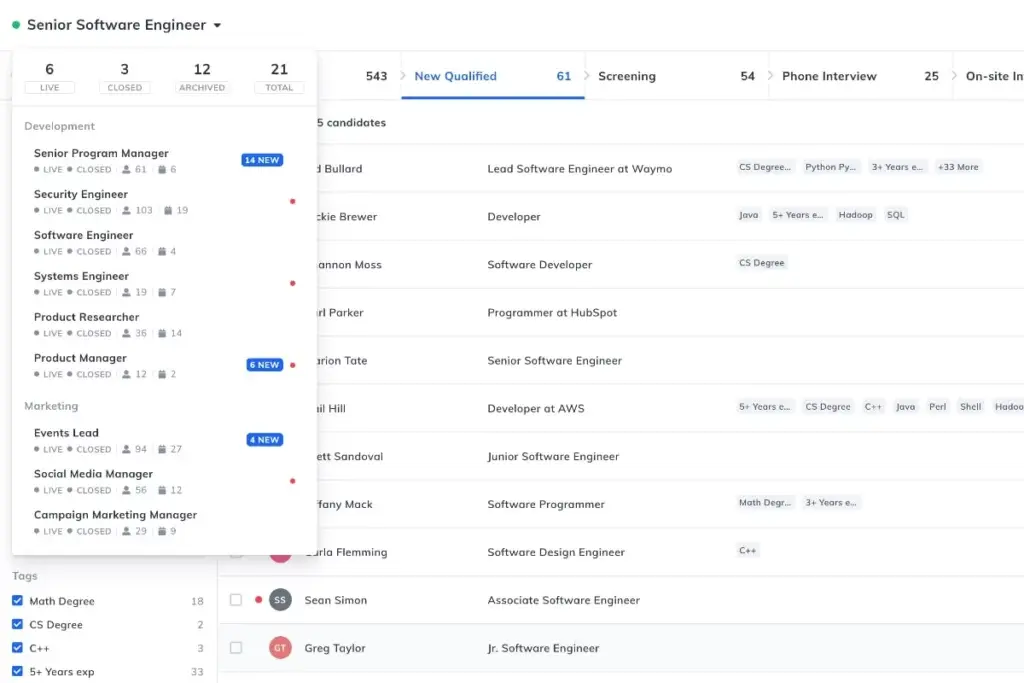
You can also automate messages and tasks within each stage and create templates for consistent messaging and workflows.
It’s important to note that GoHire is specifically geared towards startups and small to medium-sized companies. If you’re looking for a full-blown enterprise suite, this probably won’t fit the bill.
Key features:
- Visual pipeline and candidate management with ratings
- Branded careers pages and job descriptions
- AI-powered candidate matching and CV parsing
- 700+ job description templates (UK-tailored)
- Posting to 15+ job boards (Reed, Totaljobs, Indeed, LinkedIn)
- Screening questions, scorecards, and automated stage actions
- Video questionnaires and advanced reporting on Pro
-
Cheapest serious ATS on this list — Starter at $99/mo undercuts every competitor at the same feature depth
-
Unlimited team members on every plan
-
30% discount for registered charities; Early-Stage Program offers discounted Pro for qualifying startups
-
UK-built and UK-focused — strongest integrations with Reed, Totaljobs, and other UK boards
-
14-day free trial with no credit card required
-
Smaller job-board distribution network (15+) compared to Breezy (50+) or Workable
-
Reporting depth lags Ashby and Greenhouse
-
Less polished AI features than Manatal
-
Pro tier needed for video interviews and advanced reporting — expect $299/mo if you need the full kit
Pricing:
| Plan | Monthly | Active Jobs | Key Features |
|---|---|---|---|
| Starter | $99/mo (£89) | 3 | Unlimited users, CV parsing, AI matching |
| Growth | $199/mo (£149) | 10 | + Screening questions, customisable pipelines, activity feed |
| Pro | $299/mo (£249) | Unlimited | + Video questionnaires, scorecards, automated stage actions, advanced reporting |
Annual billing saves 2 months. Pro 2-year commitments save up to ~$1,900. 30% off for registered charities. Discounted Pro available for qualifying early-stage startups for up to 12 months.
Is GoHire the right ATS for you?
UK-based startups and small businesses (under 100 employees) that want a clean, affordable ATS with proper UK job-board coverage. If your hiring is mostly in the UK and you don’t need a 50-board global distribution network, GoHire is the price-performance pick.
Open GoHire's WebsiteUS-focused teams with deep job-board syndication needs, high-volume recruiting (50+ active roles), or any team that prioritises advanced analytics. Workable or Greenhouse will serve you better.
By Type of Business
The best ATS depends on what you’re hiring for, where you’re based, and how much recruiting capacity you have. Here’s my take on the strongest contenders for different types of business.
Best ATS for startups
Winner: Breezy. Runner-up: Manatal.
Breezy is the ATS we use ourselves at Venture Harbour, and it's the one I'd recommend to any founder making their first proper round of hires. The reason is unit economics: Breezy doesn't charge per seat. So your engineering lead, your marketing lead, and your CEO can all collaborate on a candidate without three separate licences eating into your runway. At $157/mo on the Startup plan, you get unlimited users, unlimited candidates, and stage-triggered automation that genuinely cuts the busywork.
The Bootstrap (free) plan is also a legitimate option if you only have one role open at a time — it's the same product, just capped at 1 active position. Most founders end up upgrading once they're hiring across two or three roles concurrently, but you can validate the workflow at zero cost first.
Manatal is the runner-up if your single biggest constraint is cost and you want AI features. At $15/user/mo (annual), it's the cheapest "real" ATS on the market, and the AI Interviewer can save you hours of phone-screen time on high-volume roles. The trade-off is depth — reporting and customisation are basic — but for an early-stage team that needs candidates in the door fast, Manatal punches above its price.
Best ATS for small businesses
Winner: Breezy. Runner-up: GoHire.
Once you're past the founder-only hiring stage and have between 10 and 200 employees, Breezy still does the job — and you'll feel the value of the unlimited-user pricing more, not less. Department heads can scorecard candidates without you buying them a seat. The Growth plan ($273/mo annual) adds reference checks, interview guides, and self-scheduling — the features that meaningfully cut interview admin once you're hiring across multiple departments.
If your team is UK-based, GoHire deserves serious consideration. At $99/mo Starter, it undercuts Breezy for teams that don't need 50+ job board distribution and where Reed and Totaljobs matter more than US-focused boards. The 14-day trial with no credit card required is the fastest way to see if it fits.
If you also want to consolidate HR (onboarding, time-off, benefits), look at the Mid-size tab — that's where BambooHR earns its place.
Best ATS for mid-size companies
Winner: Ashby. Runner-up: Workable.
Mid-market is where the ATS decision starts to seriously matter. You're hiring 20+ roles per year, you have someone whose job is to manage recruiting, and the difference between "good enough" and "actually data-driven" affects real outcomes. Ashby is the platform that consistently wins this segment for VC-backed scale-ups, and Foundations at $400/mo (under 100 employees) has finally made it transparent enough to evaluate without a sales call.
What you're paying for is the analytics: pass-through rates by stage, interviewer calibration, source effectiveness, and pipeline-health forecasts. None of the cheaper tools come close. The trade-off is configuration overhead — expect weeks of setup, not hours — which is why Ashby only makes sense once you have a dedicated Head of Talent.
Workable is the runner-up if you want recruiting plus light HRIS in one platform. The 400M+ candidate database is the genuine differentiator — if you're hiring for hard-to-fill roles, it saves you a separate LinkedIn Recruiter subscription. At $299/mo Standard, it's a step up from small-business tools without the Ashby learning curve.
Best ATS for enterprise
Winner: Greenhouse. Runner-up: Lever.
At enterprise scale (500+ employees, hundreds of hires per year, multiple business units, procurement involved), the shortlist narrows to platforms that pass an enterprise security review. Greenhouse is the reference standard here. SOC 2, GDPR, audit logs, role-based permissions, SSO, developer sandbox, 500+ integrations — and the structured-hiring methodology baked in is what most large companies actually want from an ATS.
Expect to pay $25,000–$70,000+ per year on the Pro tier, plus $2,000–$8,000 implementation. That sounds expensive, but Greenhouse genuinely scales to thousands of employees without falling over, and the integration marketplace means you almost certainly won't hit a "we can't connect to that" problem.
Lever is the runner-up if proactive sourcing is core to how you hire — exec search, hard-to-fill engineering roles, competitive talent markets. The combined ATS + CRM lets you nurture passive candidates over months before they're ready to apply. Pricing runs $63K–$144K+ per year at enterprise scale, comparable to Greenhouse Pro.
Best ATS for recruitment agencies
Winner: Manatal. Runner-up: Zoho Recruit (Staffing Agency edition).
Recruitment agencies have a different set of needs from in-house hiring teams: you're managing client relationships and candidate pipelines simultaneously, often across dozens of active mandates. Manatal is built specifically for this. The platform includes a full Recruitment CRM module — track clients, log activities, and manage placements — alongside the standard ATS pipeline. It's also the cheapest agency-friendly tool on this list at $15/user/mo (annual).
The 600M+ candidate sourcing hub and AI scoring make Manatal particularly strong for agencies running multiple searches in parallel — you can pull candidates from LinkedIn and 20+ social platforms without paying for separate sourcing tools. The AI Interviewer is also a genuine time-saver if you're conducting hundreds of first-round screens per month.
Zoho Recruit's Staffing Agency edition is the runner-up. It's not as modern as Manatal, but the native CRM features, client portal, vendor management, and integration with the broader Zoho ecosystem (Books, Mail, CRM) make it a strong choice for agencies that already run on Zoho. Standard pricing starts at $25/user/mo annual.
Best free ATS
Strictly speaking this isn't a type of business, but plenty of bootstrapped founders just want something that does the job at $0/mo.
Zoho Recruit's Forever Free plan is the most usable free ATS on this list. One active job, candidate management, email integration, and interview scheduling — all without a time limit. If your hiring is light or sporadic, you can run an entire hiring cycle without paying. The catch: only 1 active job at a time, and the interface feels dated next to modern competitors. Once you're hiring across multiple roles, the upgrade to Standard ($25/user/mo annual) is the cheapest paid option here.
Breezy's Bootstrap plan is the better fit if candidate experience matters to you. Same constraint — 1 active position — but with a far more polished pipeline, branded careers page, and 50+ job-board distribution. 30-day candidate retention is the catch, so you can't sit on a candidate database for months without paying. For most early-stage founders, this is the right "test before you commit" pick.
Beyond those two: Manatal offers a 14-day free trial (no credit card) with full AI features — useful if you want to evaluate the product before committing. Workable offers a 15-day free trial of the Standard plan including the 400M candidate database. There are no other genuine free ATS options on this list.
How to Choose the Best ATS for Your Company
When it comes to choosing the right ATS for your company, several factors will come into play.
To break it down, you’ll want to consider:
- Pricing
- Features
- Extendability
- Integrations
- Complexity
- Hiring stack
The most fundamental question to ask when evaluating solutions is which type of hiring software you truly need for your current and future hiring needs.
Most of the applicant tracking systems here can be divided into 2 main camps:
- Purpose-built ATS designed to simply create job postings and track candidates in the pipeline
- All-in-one HR solutions with ATS functionality plus onboarding, employee management, compliance, and more
If you’re looking for option 1, then a solution like BreezyHR or GoHire are likely to be best suited for your needs.
Under option 2, we love the full suite of features offered by Workable, BambooHR, and Greenhouse.
ATS Price Comparison
Finally, there’s the question of bang for the buck.
Based on our evaluation of dozens of options—and our top picks listed here—we’ve broken down the full range of options by their pricing and have followed this with a comparison that takes into account features.
| Tool | 1 active job | 3 active jobs | 10 active jobs |
|---|---|---|---|
| Breezy | Free (Bootstrap) | $157/mo (Startup, annual) | $157/mo (Startup, annual) |
| GoHire | $99/mo (Starter) | $99/mo (Starter) | $199/mo (Growth) |
| Manatal | $15/user/mo (Pro, annual) | $15/user/mo (Pro, annual) | $15/user/mo (Pro, annual) |
| Zoho Recruit | Free | $25/user/mo (Standard, annual) | $25/user/mo (Standard, annual) |
| Workable | $299/mo (Standard) | $299/mo (Standard) | $299/mo (Standard) |
| Teamtailor | ~$229–400/mo | ~$300/mo | ~$500–700/mo |
| Ashby | $400/mo (Foundations) | $400/mo (Foundations) | $400/mo (Foundations) |
| BambooHR | $250/mo min (≤25 employees) | ~$10/employee/mo (Core) | ~$10/employee/mo (Core) |
| Lever | ~$4–8K/yr | ~$4–8K/yr | ~$8–12K/yr |
| Greenhouse | ~$6–10K/yr (Core, <50 employees) | ~$6–10K/yr (Core) | ~$10–18K/yr (Core) |
You’ll notice that no matter your budget or the complexity of the solution you’re looking for, one of these tools is almost certainly right for your needs.
Based on the above criteria, you can safely decide whether you’re looking for a high-end solution with more end-to-end HR features, or a simpler solution that might come at a more affordable price. Or, most likely, you’ll want to look for something in the middle—an affordable solution with all of the features you need, but nothing more.
Again, our top picks here include:
Each of these solutions seems to hit a sweet spot in terms of pricing and functionality, with the more comprehensive HR suites demanding a higher price but also including a fuller range of features for talent management.
No matter which ATS you choose, you’ll likely be grateful to have a system in place to make hiring faster, easier, and more organised.
Take a few options for a test drive, figure out which one meets your needs, and then forge ahead.