


The best email marketing software depends on your business. If you’re running an eCommerce site, Omnisend is hard to beat. If your list is growing but you send fewer than 2,500 emails a month, Constant Contact is unusually cheap.
If you want polished emails without a learning curve, Mailchimp has the easiest builder I’ve tested. If the budget is tight, Sender and EmailOctopus cost a fraction of the big names as your list grows.
For most other small businesses, ActiveCampaign is still the best general email automation platform, particularly given its AI features.
Which tool fits you?
Question 1 of 2
What will you mostly be sending?
Where does the store run?
What matters most right now?
How will the newsletter make money?
My pick for your store
Omnisend is the strongest Shopify email platform I've tested. The product picker, abandoned-cart flows and revenue attribution plug straight into your store, and it undercuts Klaviyo at every contact tier. Outside eCommerce its automation is thinner than ActiveCampaign's.
Free to 250 contacts · from $16/mo · switching from Klaviyo or Mailchimp? Omnisend migrates you for free
Close second: ActiveCampaign — if the store is one arm of a bigger business and you need deeper automation across all of it.
My pick for your store
Omnisend's WooCommerce integration gets you the same pre-built cart-recovery flows and revenue attribution that made it my #1 for eCommerce — you can trace sales back to individual emails. Outside store emails its automation is thinner than ActiveCampaign's, but for a store that's the right trade.
Free to 250 contacts · from $16/mo · switching from Klaviyo or Mailchimp? Omnisend migrates you for free
Close second: ActiveCampaign — if the store is one arm of a bigger business and you need deeper automation across all of it.
My pick for your store
Omnisend is my #1 for eCommerce whatever the platform — BigCommerce, Wix, or a custom cart via its API. Revenue attribution and omnichannel email-plus-SMS flows are the draw. Outside store emails its automation is thinner than ActiveCampaign's.
Free to 250 contacts · from $16/mo · switching platforms? Omnisend migrates you for free
Close second: ActiveCampaign — if your cart is unusual enough that native integrations matter less than raw workflow power.
My pick for your business
I've run ActiveCampaign across my own businesses for 14 years, so weigh that as you will. Its workflow builder (135+ triggers, split-testable automations) and Active Intelligence are still the benchmark. The learning curve is real: budget a weekend to get comfortable.
From $15/mo at 1,000 contacts · no free plan — 14-day trial
Close second: Mailchimp — if ease of use ends up mattering more than automation depth.
My pick for simplicity
Campaigner ships with genuinely useful AI out of the box — subject lines, content and segment suggestions benchmarked against your own send history. You avoid the learning curve that makes ActiveCampaign a slog in week one. Reporting is thinner than the big names, mind.
From $14/mo at 1,000 subscribers · 30-day trial, no free plan
Close second: Sender — if you'd rather start on a free plan.
My pick for ease of use
Mailchimp's builder is the one I'd hand to someone who has never sent a campaign. Templates, content blocks and Canva images are all where you'd expect them. Automation is lighter than ActiveCampaign's, so it suits businesses where the emails themselves are the job.
Free to 250 contacts · Essentials from $13/mo · Standard from $20/mo
Close second: ActiveCampaign — once your automations start doing more of the work than your campaigns.
My pick for your budget
Sender includes automation on its free plan, and Claude can build welcome sequences in it for you. Native actions for other apps are thin. For newsletters and follow-ups on a budget, though, it's hard to get more for the money.
Free to 2,500 subscribers · Standard $69/mo at 10,000
Close second: Brevo — if your list is big but you only email it occasionally.
My pick for big lists
EmailOctopus costs $44.50/mo at 10,000 subscribers and $345/mo at 100,000, less than a third of ActiveCampaign at that size. The builder is simple and support answered me in under two minutes. Design control and automation actions are limited, which is the trade.
Free to 2,500 subscribers · Pro $44.50/mo at 10,000
Close second: Sender — a bigger free sending allowance, plus AI workflow building through Claude.
My pick for your newsletter
Beehiiv takes 0% of your subscription revenue on paid plans and has an ad network built in, so the newsletter can start paying for itself. It's newsletter-only, though: if you later want proper automation or a store, you'll outgrow it.
Free to 2,500 subscribers · Lite from $59/mo · $139/mo at 10,000
Close second: Sender — if you need newsletters and automated follow-up for your own products.
My pick for B2B
ActiveCampaign gets you CRM integration, lead scoring and the best workflow builder in the category from $15/mo. That's most of what B2B teams actually use HubSpot for, at a fraction of the price. Its built-in CRM suits small sales teams — a big pipeline will want Pipedrive or Salesforce alongside.
From $15/mo at 1,000 contacts · 14-day trial
My pick for developers
Resend is an API — you send email from code, with 3,000 free emails a month. It's the obvious choice for password resets and product notifications, and the wrong one for marketing campaigns (there's no real campaign tooling, by design).
Free 3,000 emails/mo · no affiliate relationship here — I just rate it
Need marketing email too? Brevo does transactional and campaigns under one roof.
The 10 Best Email Marketing Tools at a Glance
| Tool | Best For | Price From | Free Plan? | Our Rating | Try It |
|---|---|---|---|---|---|
 Omnisend | eCommerce | $16/mo | Yes — 250 contacts | 4.6/5 | Try free → |
 ActiveCampaign | AI & automation | $15/mo | Trial only (14 days) | 4.0/5 | 14-day trial → |
 Constant Contact | Small businesses sending infrequently | $6/mo | Trial only | 3.8/5 | Start for $6/mo → |
 Mailchimp | Ease of use | $13/mo | Yes — 250 contacts | 4.3/5 | Try free → |
 Sender | Most features for the money | $9/mo | Yes — 2,500 subscribers | 4.5/5 | Start free → |
 EmailOctopus | Large lists on a small budget | $10/mo | Yes — 2,500 subscribers | 4.25/5 | Start free → |
 Beehiiv | Newsletters | $0 (free to 2,500 contacts) | Yes — 2,500 contacts | 4/5 | Start free → |
 Brevo | Affordable automation | $0 (300 emails/day) | Yes — 300 emails/day | 4.1/5 | Start free → |
 Campaigner | SMBs wanting simple AI email | $14/mo | 30-day free trial | 3.9/5 | 30-day trial → |
 Resend | Developers (API-first) | $0 (3,000 emails/mo) | Yes — 3,000 emails/mo | 4/5 | Start free → |
Entry prices, verified October 2026.
See detailed pricing at 5K, 10K, 25K, and 100K contacts. For every scoring criterion, weighting and result, the full dataset is public.
01Omnisend
Test Lab Partner (Paid)Omnisend is a member of our Test Lab Programme, which means we receive a fee to conduct hands-on testing of their platform. Learn more about our Test Lab Programme →Best email marketing software for eCommerce
Omnisend is the best email marketing platform I’ve tested for eCommerce businesses. Its revenue attribution is more granular than Klaviyo’s, its omnichannel workflows are smooth as butter, and it costs significantly less.
If you’re running a Shopify or WooCommerce store and you’re not using Omnisend, there’s potentially some revenue being left on the table.
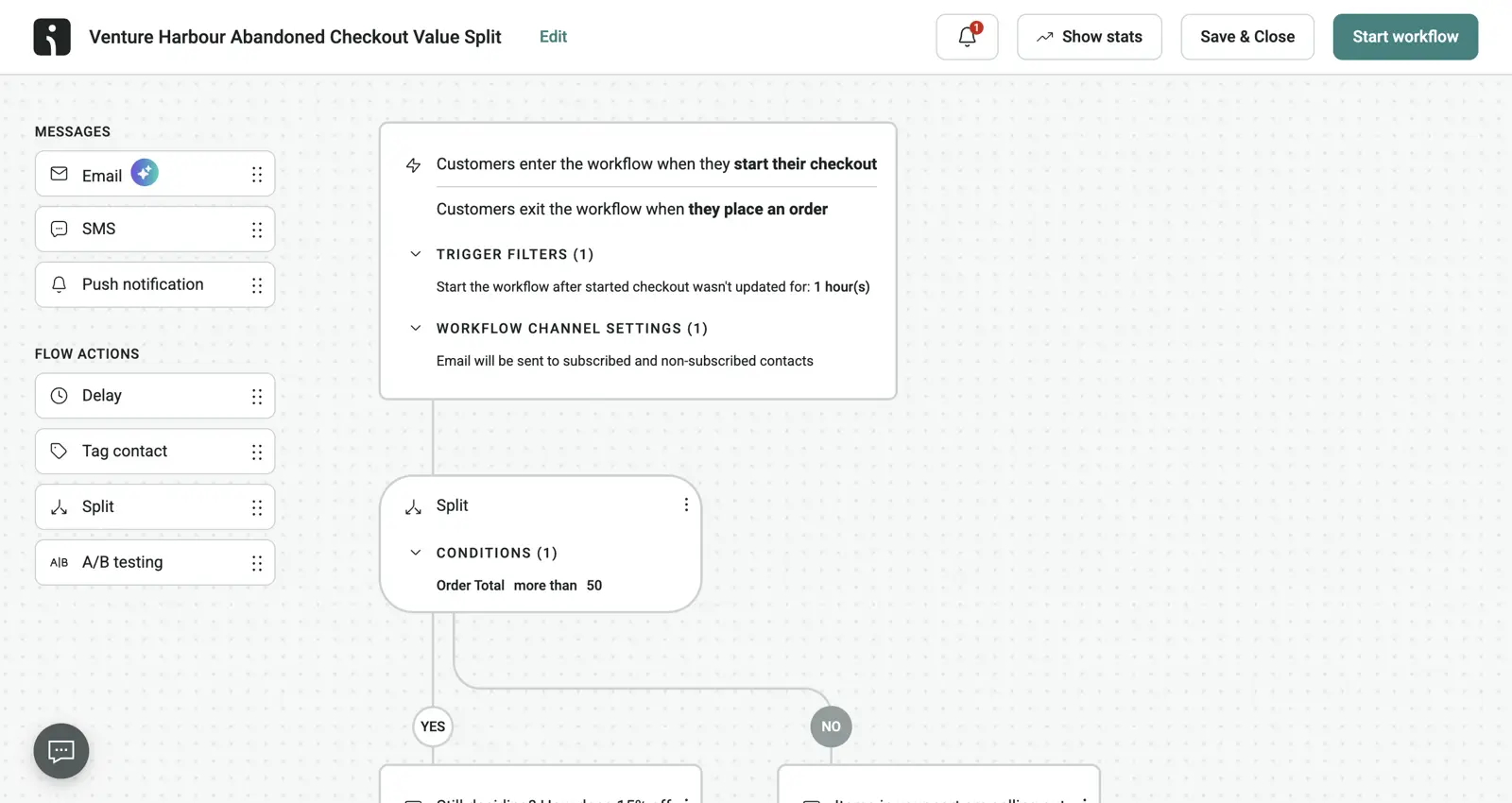
As the name implies, its focus is dialling in the omnichannel experience. It can trigger a push notification if an email isn’t opened, followed by an SMS if the push is ignored. This is more native and less buggy than the integrations you’d stitch together with other platforms.
Pros and Cons
-
Revenue attribution that actually works: Tracks revenue back to specific emails and automations with more granularity than any other eCommerce platform I’ve tested.
-
Native omnichannel workflows: Combine email, SMS, and web push in a single automation. Fallback logic is built in, rather than stitched together via third-party integrations.
-
Shopify integration depth: Product picker pulls from your catalogue, abandoned cart triggers fire reliably, and product recommendations use actual purchase history. 4.8-star Shopify app rating with 5,000+ five-star reviews.
-
Better value than Klaviyo: At 10K contacts, Omnisend Standard costs $132/mo versus Klaviyo’s $150+. Comparable features for meaningfully less money.
-
Free migration from Klaviyo (or any ESP): The biggest barrier to switching ESPs is the migration itself. Omnisend handles it for you at no cost. Their team manages list imports, automation rebuilds, template recreation, and deliverability setup, so the switch costs are minimal.
-
Free plan is essentially a demo: 250 contacts and 500 emails/month is barely enough to test, let alone run a business. Budget for Standard from day one.
-
Email template builder is mid-tier: Templates feel dated and customisation options are limited. If brand design matters, expect workarounds.
-
Segmentation is shallow beyond purchase data: Excels at purchase-based segmentation but weaker for behavioural signals beyond transactions.
-
Email send limits on Standard: Capped at 12x your contact list per month. Fine for most stores, but daily promotions will hit the ceiling.
-
Not great outside eCommerce: If you’re not running a store, Omnisend is the wrong tool. Its entire feature set assumes you’re selling products online.
Pricing
| Contacts | Standard | Pro |
|---|---|---|
| 500 | $16/mo | $59/mo |
| 5,000 | $81/mo | $90/mo |
| 10,000 | $132/mo | $150/mo |
| 100,000 | Custom quote | Custom quote |
At 10K contacts, Omnisend Standard ($132/mo) is comparable to ActiveCampaign Starter ($149/mo), and for eCommerce the native Shopify integration and revenue attribution justify the choice. At 100K+, Omnisend moves to custom quotes while ActiveCampaign charges $1,199/mo on Starter — but Omnisend typically costs less than Klaviyo at scale.
Omnisend’s AI is one of the strongest in the eCommerce space, and it’s the area of the platform that has improved most over the past year. The AI writer is trained on millions of real campaigns, so the subject lines, preheaders, and body copy it generates sound on-brand rather than the obvious LLM filler you get elsewhere. One smart touch I like is the Brand Assets AI which keeps voice and visual identity consistent across every campaign and automation.
The standout is the natural-language segment builder. Describe the customer you want to reach in plain English (“lapsed buyers who spent over $200 last year”) and it builds the segment for you. It draws on churn prediction and high-value-customer scoring under the hood.
Is Omnisend the right eCommerce email platform for you?
Any Shopify or WooCommerce store doing more than $100k/year in revenue. If you need abandoned cart emails, product recommendations, SMS marketing, and detailed revenue attribution in a single tool, Omnisend is the clear choice.
Non-eCommerce businesses. If you’re B2B, a creator, or anything that doesn’t involve selling products through an online store, Omnisend’s feature set will feel irrelevant. Look at ActiveCampaign, Mailchimp or EmailOctopus instead.
One more thing worth knowing if you’re on Klaviyo or Mailchimp and tempted: Omnisend runs a free migration service. Their team rebuilds your lists, automations, and templates at no cost — it’s their offer, not mine, but it removes the main excuse for staying put.
Switching platforms? Omnisend migrates you for free →
02ActiveCampaign
Test Lab Partner (Paid)ActiveCampaign is a member of our Test Lab Programme, which means we receive a fee to conduct hands-on testing of their platform. Learn more about our Test Lab Programme →Best email marketing platform for AI & automation
ActiveCampaign still has one of the best automation builders in the industry, and their AI offering has taken this to another level.
We’ve used ActiveCampaign for 14 years across 8 of our portfolio companies and sent 124,000+ emails on their platform, so we’re acutely aware of its strengths and shortcomings.
It’s no longer the cheapest (in 2024, they hiked their pricing… ruffling many a feather), but at scale it’s reasonable compared to alternatives that offer a fraction of the functionality.
I started using ActiveCampaign in 2012, back when it was a scrappy underdog and one of the first tools with visual automation. For a few years, the company seemed a bit rudderless.
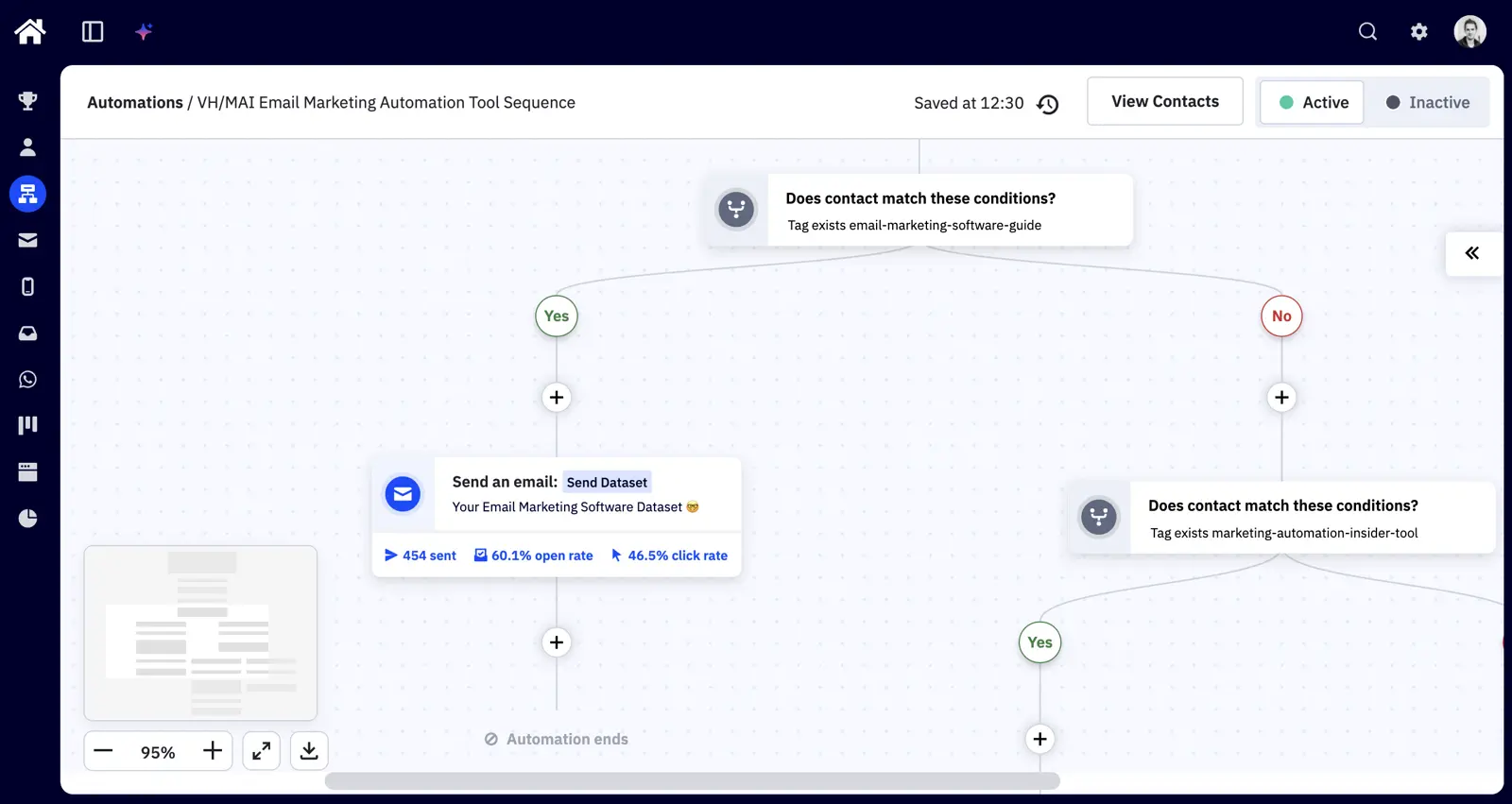
But their automation offering is still in a league of its own. I’ve tested every major competitor, and nothing comes close to ActiveCampaign’s visual workflow editor for building complex, multi-step sequences. You get 135+ automation triggers and can split-test entire automation paths. As of 2026, AI can now do the grunt work that once took days.
ActiveCampaign also gets the boring bits right. Compliance, security, deliverability — the stuff that determines whether your emails reach the inbox.
Pros and Cons
-
Results Guarantee – It’s the only platform to guarantee marketing results. ActiveCampaign now backs new customer subscriptions with a full first-month refund if they don’t see improvements.
-
1,000+ integrations – ActiveCampaign has more than 1,000 integrations including native integrations with Salesforce, Calendly, Webflow, Zendesk, DocuSign, and most major eCommerce platforms like Shopify, Magento, and WooCommerce.
-
Visual automation builder is best-in-class: 135+ triggers, if/else branching, split-testing entire automation paths. Running our own sequences as continuous A/B tests has produced 4-5× uplifts in open rates on our most-tested flows.
-
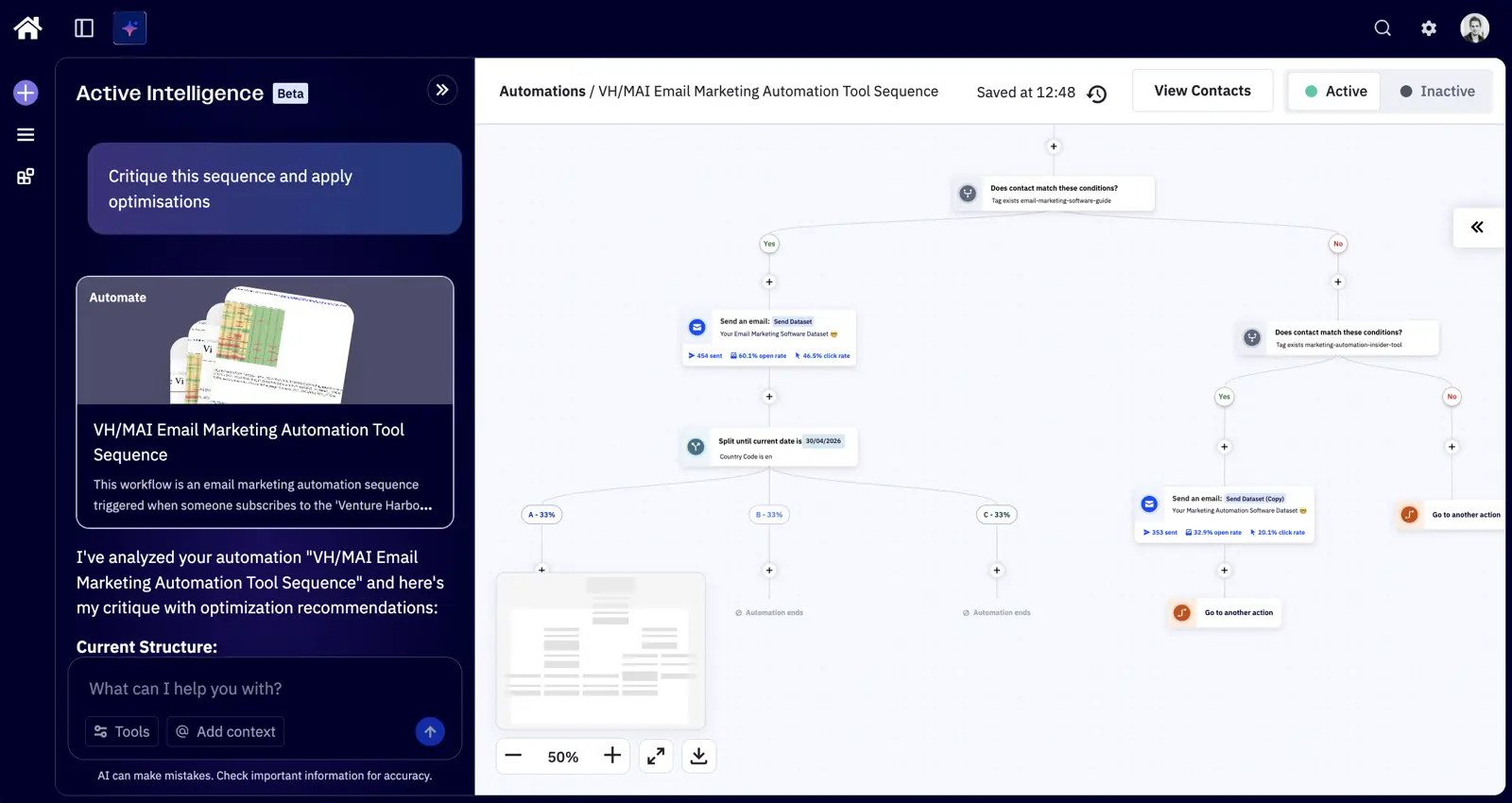
Active Intelligence is actually good: I was sceptical when it first launched that it’d just be a ChatGPT wrapper. But ActiveCampaign’s AI builds context from your previous campaigns, writing style, and engagement patterns. It can build decent workflows in minutes.
-
Predictive sending per contact: Analyses each subscriber’s engagement history and delivers when they’re personally most likely to open, rather than blasting the whole list at 10am (Pro plan).
-
Deliverability is top-notch: 99.4% delivery rate across our own accounts, and my default test email scored 9.5/10 in Mail Tester. ActiveCampaign’s own study puts inbox placement at 94.2%, against an ~83% industry average. SPF, DKIM, and DMARC setup is guided by a built-in wizard.
-
Cost scaling is reasonable for a per-contact tool: The 1K-to-100K multiplier is roughly 80x ($15/mo to $1,199/mo on Starter). That’s steep, but consider that HubSpot scales at 59x just between Starter and Professional — before you even reach 100K contacts.
-
The 2024 missteps damaged trust: Long-time customers saw bills jump 30-40% overnight with little warning. Our migration data shows a spike in departures in late 2024.
-
The CRM isn’t suitable for large teams – ActiveCampaign’s CRM will likely suffice for smaller sales teams, but larger teams or high deal volumes will likely need a separate CRM like Salesforce or Pipedrive.
-
Reports are bland – Since ActiveCampaign introduced goal tracking and attribution, reports have more useful data, but building reports still feels weaker than in Klaviyo or HubSpot.
-
New accounts pay for dead contacts: Since November 2025, new accounts are billed for every contact, including unsubscribed and bounced ones. On Plus, 9,000 active contacts plus 2,500 dead ones tips you from the $189/mo tier into the $389/mo tier. That’s about $2,400 a year for people you can’t email.
-
Support quality is increasingly AI: Maybe this is just the way the world is moving, but expect to wade through 2-3 emails from an AI before an actual human contacts you.
-
Overwhelming for simple use cases: If you just want to send a monthly newsletter, ActiveCampaign is overkill. Campaigner or EmailOctopus will serve you better at a fraction of the cost.
Pricing
ActiveCampaign uses per-contact pricing across four tiers: Starter, Plus, Pro, and Enterprise. No free plan — just a 14-day trial. The prices below are on annual billing; paying month to month costs about a quarter more.
If you’re choosing ActiveCampaign, budget for Plus (it’s what we use) or Pro. Starter can’t run If/Else branches, and branching is most of the reason to pick ActiveCampaign in the first place.
| Contacts | Starter | Plus | Pro |
|---|---|---|---|
| 1,000 | $15/mo | $49/mo | $79/mo |
| 10,000 | $149/mo | $189/mo | $375/mo |
| 100,000 | $1,199/mo | $1,599/mo | $2,599/mo |
At 10,000 contacts, ActiveCampaign Starter ($149/mo) is pricier than Campaigner ($79/mo) but offers vastly more powerful automation. At 100K contacts, Starter jumps to $1,199/mo — a steep climb, but you get the automation depth no budget tool can match.
ActiveCampaign’s AI — branded “Active Intelligence” — gives you the following:
- Content generation trained on your brand: It learns your writing style and audience preferences from previous campaigns.
- Predictive sending: Per-contact send-time optimisation based on individual engagement patterns (Pro plan).
- Win probability and churn prediction: Scores deals by likelihood of closing and flags contacts at risk of disengaging.
- AI-generated automation workflows: Describe what you want in plain language, and it builds the workflow.
Plenty of tools slap “AI” on a feature list. ActiveCampaign’s version is useful because it speeds up the work you already do. It drafts on-brand email and automation copy, translates campaigns for different audiences, and surfaces smarter segments from engagement data. You get a decent first draft in minutes, then improve it with guidance based on what’s actually performed for you.
In my latest test, I pointed it at an onboarding sequence and asked how to lift opens and activation. It spotted an unfinished A/B test, a missing preheader and a high unsubscribe rate, then added the fixes itself. It still couldn’t build the split tests for me, so a human who understands testing remains part of the job.
Is ActiveCampaign the right email marketing tool for you?
Businesses that have outgrown basic email and need proper marketing automation. If you’re sending segmented campaigns, building multi-step workflows, scoring leads, or running sequences across more than 1,000 contacts, the value equation tips heavily in ActiveCampaign’s favour.
If you just want to send a simple newsletter, you’ll be paying for complexity you don’t need. Creators should look at EmailOctopus. Small businesses sending basic campaigns should consider Campaigner or Brevo. If your budget is under $30/month, you’ll get more for your money elsewhere.
03Constant Contact
Test Lab Partner (Paid)Constant Contact is a member of our Test Lab Programme, which means we receive a fee to conduct hands-on testing of their platform. Learn more about our Test Lab Programme →Best email marketing software for small businesses sending under 2,500 emails/month
Constant Contact is the email tool I’d consider first for a small business or solo entrepreneur building a list before sending regularly. Its Starter Email plan costs $6/month with unlimited contacts and a 2,500-send monthly cap.

Most email platforms become more expensive as your list grows, even if you barely email it. Constant Contact’s Starter Email plan lets a local business, consultant or new project keep collecting subscribers without the usual contact-count penalty.
I tested Constant Contact across eight areas in August 2026. It scored 30 out of 40, with its strongest results coming from pricing, deliverability, support and the email builder.

The email builder was easy to use, and the AI generated workable drafts after editing. The default email scored 9/10 in Mail Tester. The weak spot is automation: I built a three-email welcome sequence, but the builder lacks the behavioural depth I’d want for serious lifecycle marketing.
Pros and Cons
-
Unlimited contacts for $6/month: Starter Email keeps the bill flat while the list grows, provided you stay under 2,500 monthly sends.
-
Beginner-friendly editor: I rebuilt a designed email with minor friction and no training.
-
Good default deliverability: Our untouched test email scored 9/10 in Mail Tester, with no blocklist or formatting issues.
-
Useful support: Phone support answered in about a minute, and chat gave a sensible billing answer.
-
The Starter Email send cap is hard: a 2,500-contact list can receive one full-list campaign a month on Starter Email.
-
Automation is basic: welcome sequences are fine, but click-based and behavioural journeys belong in ActiveCampaign.
-
Design control is limited: I couldn’t add custom CSS, custom fonts or search a stock-image library in the editor we tested.
-
The AI still needs a human pass: the generated email missed a discount code from my prompt.
Pricing
| Plan | Starts at | Monthly send allowance |
|---|---|---|
| Starter Email | $6/mo | 2,500 total sends |
| Lite | $12/mo | 10x contact tier |
| Standard | $35/mo | 12x contact tier |
| Premium | $80/mo | 24x contact tier |
Starter Email is the interesting plan. At 5,000 contacts, it still costs $6/month, while the broader Lite plan starts at $80/month for that contact tier.
You can store a large list cheaply, but you cannot send to all of it often.
Is Constant Contact the right email marketing tool for you?
Small businesses, local operators and solo entrepreneurs whose lists are growing ahead of their campaign frequency. If you send fewer than 2,500 emails a month, Constant Contact’s Starter Email plan is difficult to beat.
Teams sending weekly newsletters, eCommerce campaigns or complex behavioural automations. The moment email becomes a regular revenue channel, compare ActiveCampaign, Omnisend or Brevo instead.
04Mailchimp
Test Lab Partner (Paid)Mailchimp is a member of our Test Lab Programme, which means we receive a fee to conduct hands-on testing of their platform. Learn more about our Test Lab Programme →Best email marketing software for ease of use
Mailchimp has the easiest email builder I’ve tested. Of the 130+ tools we track, it’s the one people move to most.
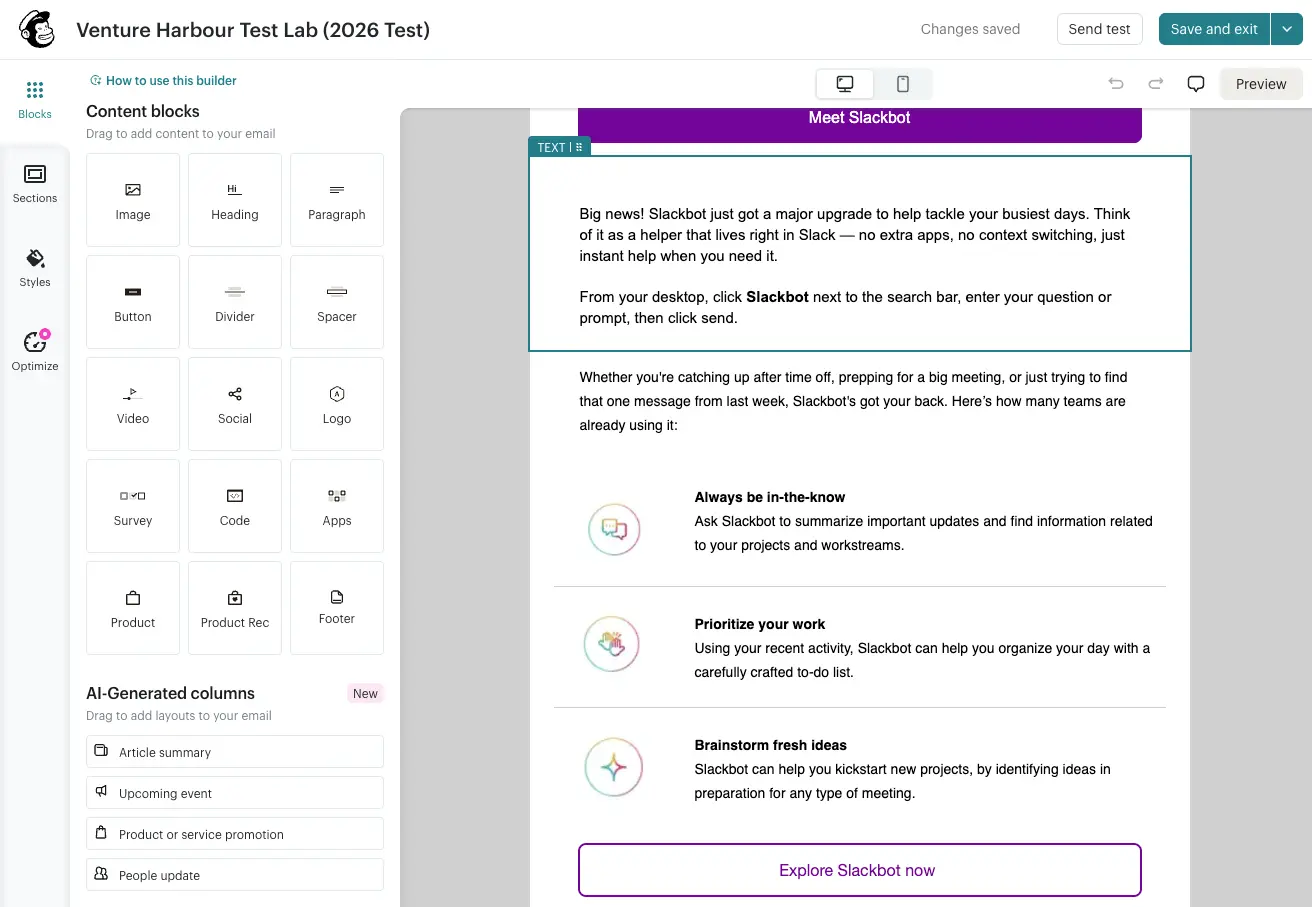
I rebuilt a newsletter campaign from Really Good Emails in eight minutes, which is faster than I’ve managed in ActiveCampaign, Omnisend or Constant Contact. It’s one of the few email builders I’ve used where I barely had to think — everything just made sense.
Support surprised me too. I asked a deliberately awkward billing question with a false premise baked in. A human agent replied, corrected it and suggested archiving contacts to lower my bill (the right answer, and one that makes Mailchimp less money).
The automation builder handles welcome sequences and simple branches well, but it won’t critique a journey for you or update a Shopify contact from inside the flow.
Pros and Cons
-
The fastest email builder I’ve tested: My rebuild got about 90% of the way to the reference design. Images come straight from Canva, Instagram, Giphy or stock libraries.
-
Human support that answers the real question: A chat agent corrected the false premise in my billing question and recommended archiving contacts, which lowered the bill.
-
Clean deliverability defaults: My default campaign scored 9/10 in Mail Tester once I adjusted for a missing DMARC policy on my own test domain. HTML and SpamAssassin checks were clean.
-
Analytics AI that reads like a person: Ask it to summarise the last 30 days and you get plain-English insights and recommendations, rather than a dashboard to decode.
-
A Claude connector that produces real drafts: Claude planned a campaign for a coffee roastery, and Mailchimp imported four email drafts and a social post ready to edit.
-
Automation is simple by design: Delays, split paths and behavioural branches are all there. AI journey planning and native actions in third-party apps aren’t.
-
The AI is still a writing assistant: Intuit Assist generates copy block by block. The Optimize tab’s suggestions were generic when I wanted it to critique the email itself.
-
The free plan is a demo: 250 contacts and 500 monthly sends is enough to test, not to run a growing newsletter.
-
You pay for contacts you can’t email: Unsubscribed contacts count towards your bill unless you archive them.
Pricing
Mailchimp prices by contacts across four plans: Free, Essentials, Standard and Premium. Most serious users will land on Standard, because Essentials caps automations at four steps with no branching.
| Contacts | Essentials | Standard | Premium |
|---|---|---|---|
| 500 | $13/mo | $20/mo | — |
| 1,500 | $26.50/mo | $45/mo | — |
| 10,000 | $110/mo | $135/mo | $350/mo |
| 100,000 | — | $800/mo | $1,025/mo |
At 10,000 contacts, Mailchimp Standard ($135/mo) undercuts ActiveCampaign Plus ($189/mo, even on annual billing) but costs three times as much as EmailOctopus. It’s no longer the cheap option it was a decade ago. Most of the difference goes on the builder and the support, which were the two best parts of my test.
Mailchimp’s AI takes a slower route than most. You pick a template first, then use Intuit Assist to generate or reshape content block by block. I prefer that to one-shot builders that hand you something 80% finished, but I wanted more critique of structure and click-through than it gave me.
The article summary block was the best of it: give it a URL and it pulls in a sensible title, summary and image.

Is Mailchimp the right email marketing tool for you?
Owner-operators, small businesses and non-technical marketers who want polished campaigns without a long setup. If your main work is newsletters, product announcements and welcome sequences, the time Mailchimp saves on every send adds up quickly.
Teams whose email runs on CRM stages, sales pipelines or complex behavioural logic, where ActiveCampaign is the better fit. Advanced Shopify stores should look at Omnisend. If price is the main constraint, Sender and EmailOctopus cost less at every list size I checked.
05Sender
Test Lab Partner (Paid)Sender is a member of our Test Lab Programme, which means we receive a fee to conduct hands-on testing of their platform. Learn more about our Test Lab Programme →Best email marketing software for getting the most for your money
If you’re a small business watching the budget, Sender is where I’d start. It had been on my radar for years without me quite understanding why I’d choose it. Eight tests later, I had two reasons: a free plan that covers a real small-business list, and an automation builder Claude can operate for you.
The free plan includes 2,500 subscribers and 15,000 emails a month, with automation included. At the full allowance, that’s six sends to your whole list every month before you pay a penny (with Sender branding on the emails).
I gave Claude a short brief for a fictional coffee roastery, and it built a three-email welcome sequence directly in my Sender account, with subject lines and delays in place. When I asked it to improve the plain first draft, it updated the email designs in Sender too.
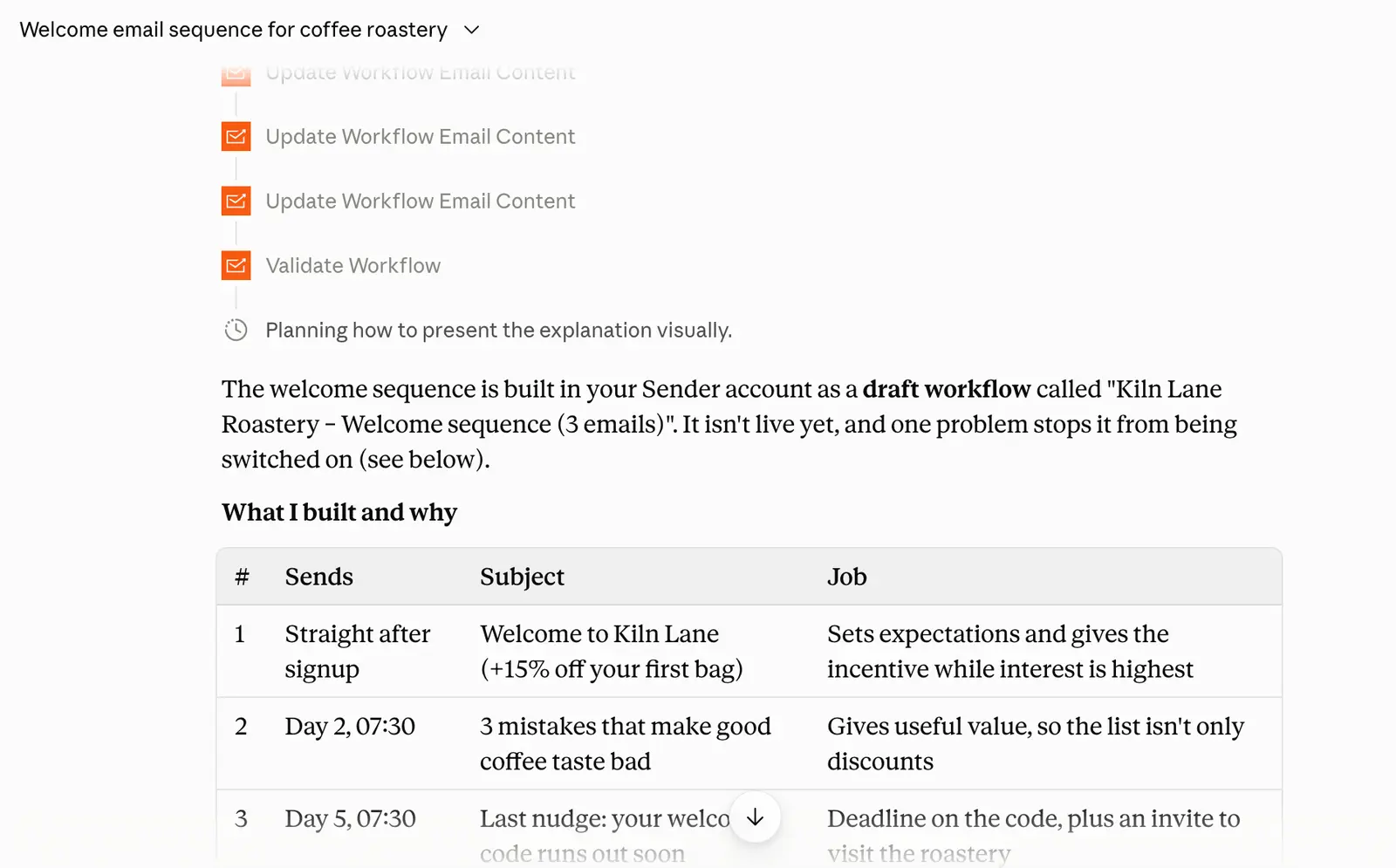
You have to connect Claude through Sender’s MCP connection first, as there’s no prompt box inside Sender itself. The sequence also stayed in draft with an activation problem flagged, so it needed checking before going live.
Support was quick when it mattered. My account was held for review, which blocked me from publishing landing pages. Two messages later, it was approved in 31 minutes.
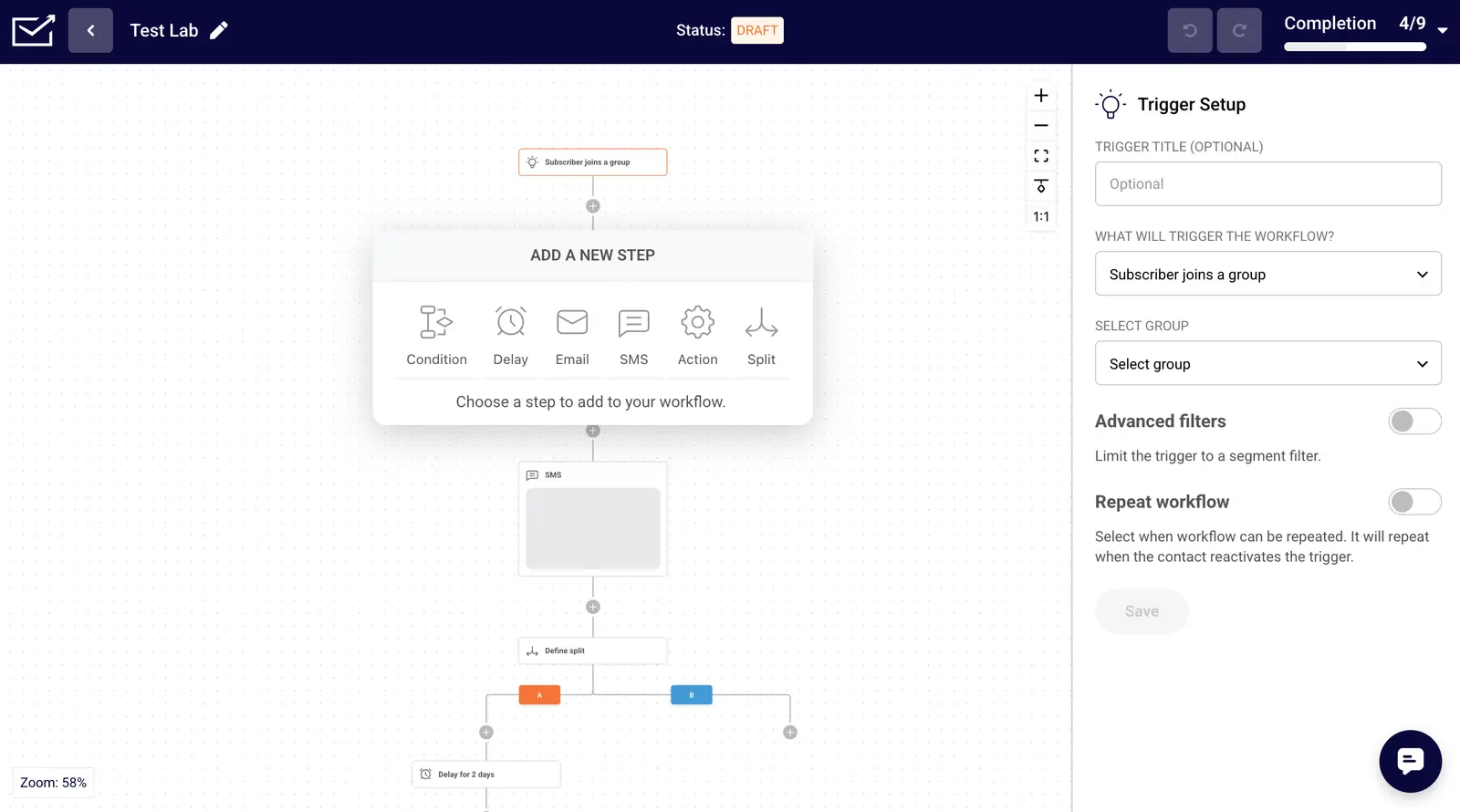
Pros and Cons
-
The most complete free plan I’ve tested: Automation is included rather than held back as an upsell, so a welcome sequence can run alongside the newsletter.
-
AI that builds the workflow itself: Claude created a three-email welcome sequence with delays and subject lines directly in my account, then improved the designs when asked.
-
Cheap as the list grows: $69/mo at 10,000 subscribers and $389/mo at 100,000 on monthly billing. ActiveCampaign Starter is $149/mo at 10,000 contacts, even on annual billing.
-
Lead capture that works first time: My landing-page signup landed in the right subscriber group, ready to trigger a welcome sequence.
-
A clean spam check: A default-template email scored 9.5/10 in Mail Tester. The only deduction was three images missing alt text.
-
The AI needs an outside assistant: Nothing happens until you connect Claude through MCP.
-
Fewer native actions for other tools: Automation focuses on activity inside Sender. Connecting a CRM means webhooks and more setup than in ActiveCampaign.
-
Imports need checking: My messy CSV test brought in the 42 expected contacts plus one extra, and field mapping was manual.
-
Account review can hold up a launch: I couldn’t publish landing pages until my account was approved.
Pricing
Sender prices by subscriber count. Paid plans remove the branding and raise your sending limit to 12x your subscriber allowance on Standard, or 24x on Professional.
| Subscribers | Standard | Professional |
|---|---|---|
| 1,000 | $15/mo | $20/mo |
| 10,000 | $69/mo | $127/mo |
| 100,000 | $389/mo | $860/mo |
Those are month-to-month prices. Sender also runs a 30% first-year discount on annual billing, which brings Standard at 10,000 subscribers down to $48.30/mo. Either way, it’s about half the price of Mailchimp Standard at that size.
Professional adds SMS automation and a larger sending allowance. I’d only pay for it if you’ll use one of those.
Sender’s AI runs through Claude rather than a built-in assistant. I’d try it if you already work in Claude and want help turning an idea into an editable sequence. Expect to review the copy, the design and the activation settings yourself before anything reaches a customer.
Is Sender the right email marketing tool for you?
Small businesses that want newsletters and automated follow-up without committing much budget. Start on the free plan with one newsletter and a welcome sequence, then upgrade when branding or list size becomes the constraint.
Teams whose automations span a CRM and other applications, which ActiveCampaign handles natively. It’s also the wrong pick if you expect to generate workflows with AI inside Sender without connecting another tool.
06EmailOctopus
Test Lab Partner (Paid)EmailOctopus is a member of our Test Lab Programme, which means we receive a fee to conduct hands-on testing of their platform. Learn more about our Test Lab Programme →Best email marketing software for large lists on a small budget
EmailOctopus is what I’d pick for sending a lot of email without the bill growing with it. It’s free up to 2,500 subscribers, $44.50/mo at 10,000 and $345/mo at 100,000. That last number is less than a third of ActiveCampaign Starter at the same size.
I first recommended it for developers in 2021. At the time, it combined Amazon SES’s low sending costs with a simple interface that made sense to non-technical users.
This time I tested it as a general email tool. It’s much friendlier than it was in 2021, and it’s still cheap.
The builder was easy enough that I’d happily hand it to a less technical teammate. I rebuilt a designed newsletter close to the original without fighting the editor.
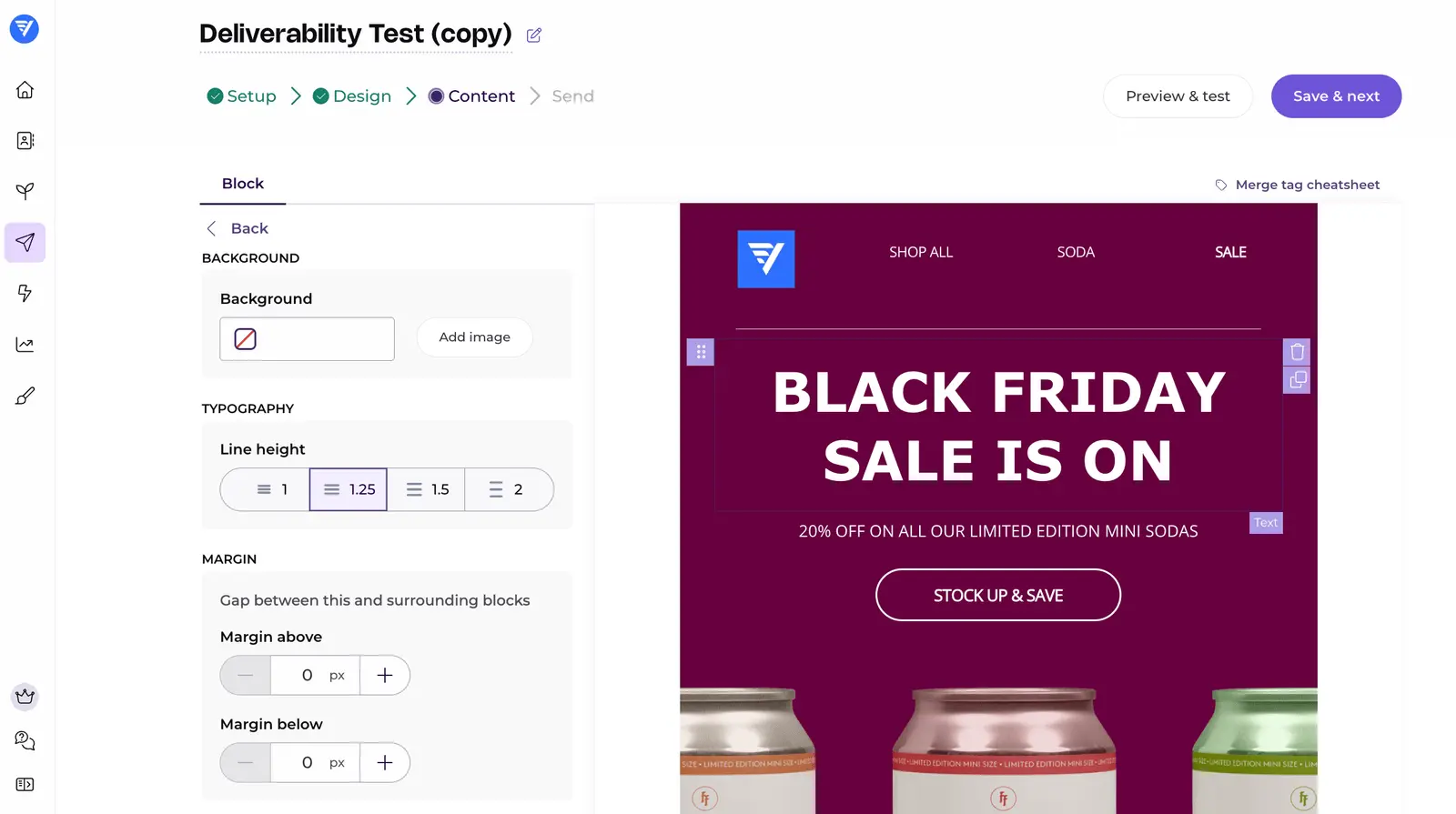
The limits show up in the small details. I wanted a 38px font and could only pick from presets, so I settled for 36px. Changing the relative width of two columns wasn’t obvious either, and button text is bold or not bold, with nothing in between.
Support was the quickest I had in this round of testing. On live chat, I was talking to a human in about 40 seconds and had a useful answer in under two minutes.
Pros and Cons
-
Pricing that stays low at scale: $44.50/mo at 10,000 subscribers and $345/mo at 100,000 on monthly billing. Annual billing trims it further.
-
A generous free plan: 2,500 subscribers and 10,000 emails a month, which is four full-list sends before any automated emails.
-
An editor non-designers can use: I got close to my reference newsletter without a struggle.
-
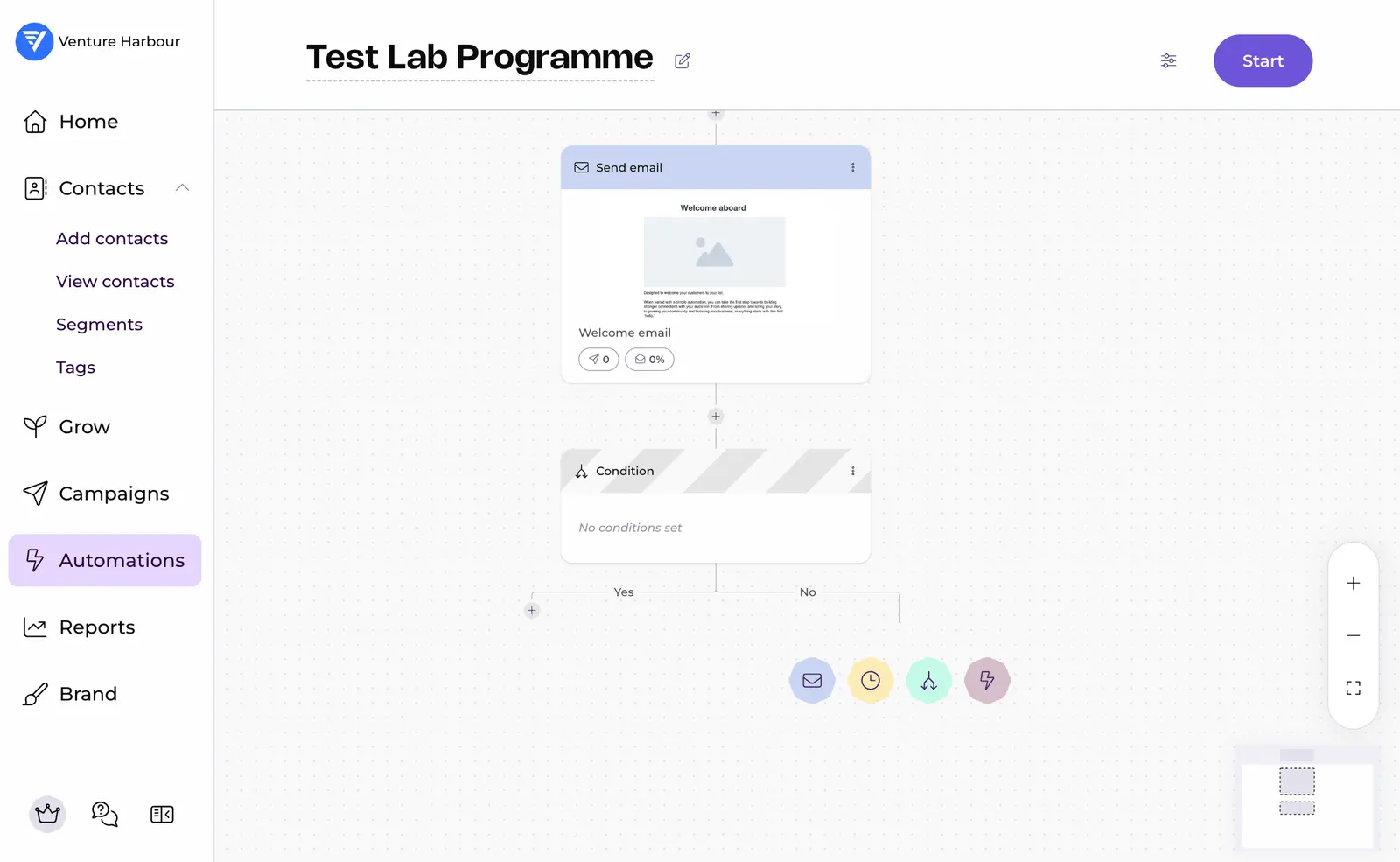
A clear automation canvas: Emails, delays and conditions on opens, clicks or tags slot in where you’d expect them.
-
Human support in under two minutes: Even an email I sent on the team’s retreat day got a reply in about 20 minutes.
-
Forgiving imports: Valid contacts came through despite errors elsewhere in the file, and the error download explained every rejected row.
-
Restricted design control: Preset font sizes, fiddly column widths and no choice of button font weight.
-
Basic landing pages: Five templates in my test, restrictive layouts, and no multi-step forms or conditional logic.
-
Limited automation actions: No webhooks or third-party app actions, and the free plan stops at five steps.
-
No true plain-text emails: Support suggested a simple HTML template instead.
Pricing
EmailOctopus has one free plan (Starter) and one paid plan (Pro), priced by subscriber count.
| Subscribers | Starter | Pro |
|---|---|---|
| 1,000 | Free | $13.50/mo |
| 2,500 | Free | $20/mo |
| 10,000 | — | $44.50/mo |
| 100,000 | — | $345/mo |
Pro removes the EmailOctopus branding, keeps your reports indefinitely rather than for 30 days, and includes unlimited landing pages, forms and users. The free plan’s 2,500 ceiling applies to contacts you store, not just the ones you email. Support confirmed you’d need Pro to keep more.
If you’d rather use your own Amazon SES account, EmailOctopus Connect charges a platform fee on top of your SES bill. I’d start with the standard service.
There isn’t much AI to talk about. EmailOctopus isn’t trying to win on it, and for a newsletter with a welcome sequence I didn’t miss it. If AI-assisted workflows matter to you, Sender or ActiveCampaign are the better bets.
Is EmailOctopus the right email marketing tool for you?
Newsletters and small businesses that need a straightforward welcome sequence, especially if the list is big relative to the budget. At 100,000 subscribers, it costs less than a third of ActiveCampaign Starter.
Workflows that need webhooks or actions in third-party apps, where ActiveCampaign is the better fit. Designers who need pixel-level control will get frustrated, and if template design is the priority, compare Mailchimp first.
07Beehiiv
Best email marketing platform for newsletters
I chose Beehiiv for my personal newsletter that I write to friends. My reasoning was mostly that Beehiiv seemed to be taking off in newsletter circles, and I wanted to understand why.
Beehiiv’s sole focus is helping you monetise your newsletter. It’s essentially an email marketing tool + newsletter ad network + cross-promotional newsletter marketplace. Let me unpack that.
The email marketing side of Beehiiv is pretty basic, but functional. You can spin up a website to capture leads, gate your content behind a paywall, and send emails to your list — all for free (up to 2,500 contacts). My only gripe is that a lot of basic features, like custom HTML and analytics, are only available on their paid plans.

In practice, basic features require an upgrade. Things I expected to be standard — like custom HTML or A/B testing — are locked behind the paid plans, which start at $59/mo on Lite. For a free newsletter, I’d start with EmailOctopus’s free plan instead.

Beehiiv is strongest when you’re running a newsletter with revenue attached. If you’re building a paid or ad-supported newsletter, the combination of built-in advertising, paid subscriptions with 0% platform fee (on paid plans), and cross-promotion is hard to beat.
It’s a bit overkill for my personal newsletter, and in hindsight I’d probably go for EmailOctopus. If I were building a paid newsletter business, though, I’d start with Beehiiv.
Pros and Cons
-
Strong newsletter monetisation: Built-in ad network, paid subscriptions with 0% platform cut (on paid plans), and a referral programme. Substack takes 10%; Beehiiv takes nothing.
-
Reasonable at scale for a monetised list: Lite is $139/mo at 10,000 subscribers and $469/mo at 100,000, well under half of ActiveCampaign Starter at that size.
-
Built for newsletter operators: Web hosting, custom domain, SEO-optimised archives, referral tracking, and audience polls — all designed around the newsletter business model.
-
Growing ecosystem: Cross-promotion between newsletters and a recommendation engine that drives subscriber growth from other Beehiiv publications.
-
Poor fit for non-monetised newsletters: Speaking from experience. Custom HTML, A/B testing, automations, referral programme, and ad network are all locked behind the paid plans (from $59/mo on Lite). If you’re not generating revenue, I’d choose EmailOctopus for its free plan.
-
Newsletter-only platform: No CRM, no lead scoring, no multi-channel automation, no eCommerce integrations.
-
Basic AI: Generic writing assistant. No learning from your audience data, no send-time optimisation.
-
Growing pains are real: Reddit reports occasional bugs and UI glitches — the rough edges of a rapidly scaling platform.
Pricing
| Plan | 1,000 subscribers | 10,000 | 100,000 | What it adds |
|---|---|---|---|---|
| Free | $0/mo | — | — | Up to 2,500 subscribers, unlimited sends, website, custom domain |
| Lite | $59/mo | $139/mo | $469/mo | + Automations, ad network, 0% take rate on paid subscriptions |
| Pro | $109/mo | $239/mo | $699/mo | + Remove branding, audio newsletters, dynamic content |
| Enterprise | Custom | Custom | Custom | + Dedicated account manager and IPs |
Those are month-to-month prices; annual billing takes about 15% off. At 100K subscribers, Beehiiv Lite costs $469/mo, against $1,199/mo for ActiveCampaign Starter, though EmailOctopus and Sender are cheaper still. If your newsletter generates revenue, the 0% take rate matters more than the subscription.
Basic — a writing assistant for content and subject lines. It doesn’t learn from your data or optimise send times. The monetisation tools are the reason to choose Beehiiv.
Is Beehiiv the right newsletter platform for you?
Newsletter creators who plan to monetise — through paid subscriptions, advertising, or both. Also worth considering if you expect rapid subscriber growth and want predictable costs.
Open Beehiiv's WebsiteFor a free newsletter with no plans to monetise, EmailOctopus is a better fit. If you need marketing automation, ActiveCampaign is a better fit. For eCommerce, Omnisend is a better fit. Beehiiv is a specialist tool for a specific business model.
08Brevo
Best affordable email marketing service for simple automation
Brevo (formerly Sendinblue) is a useful “stepping stone” email marketing tool for businesses that have outgrown basic email but aren’t ready for ActiveCampaign. It’s simple, affordable, and prices by email volume rather than contacts, which makes it cost-effective for large lists with low send frequency.
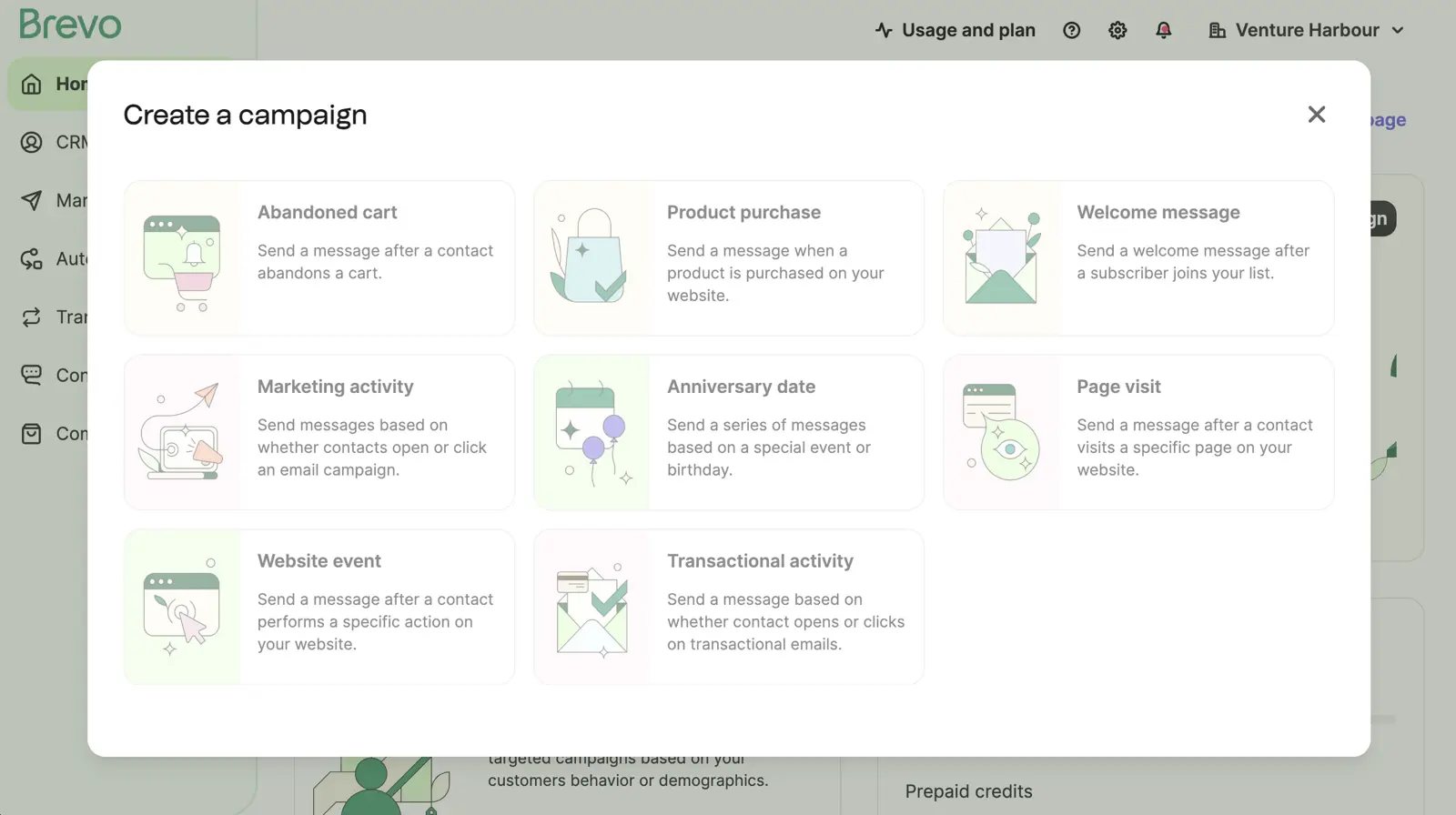
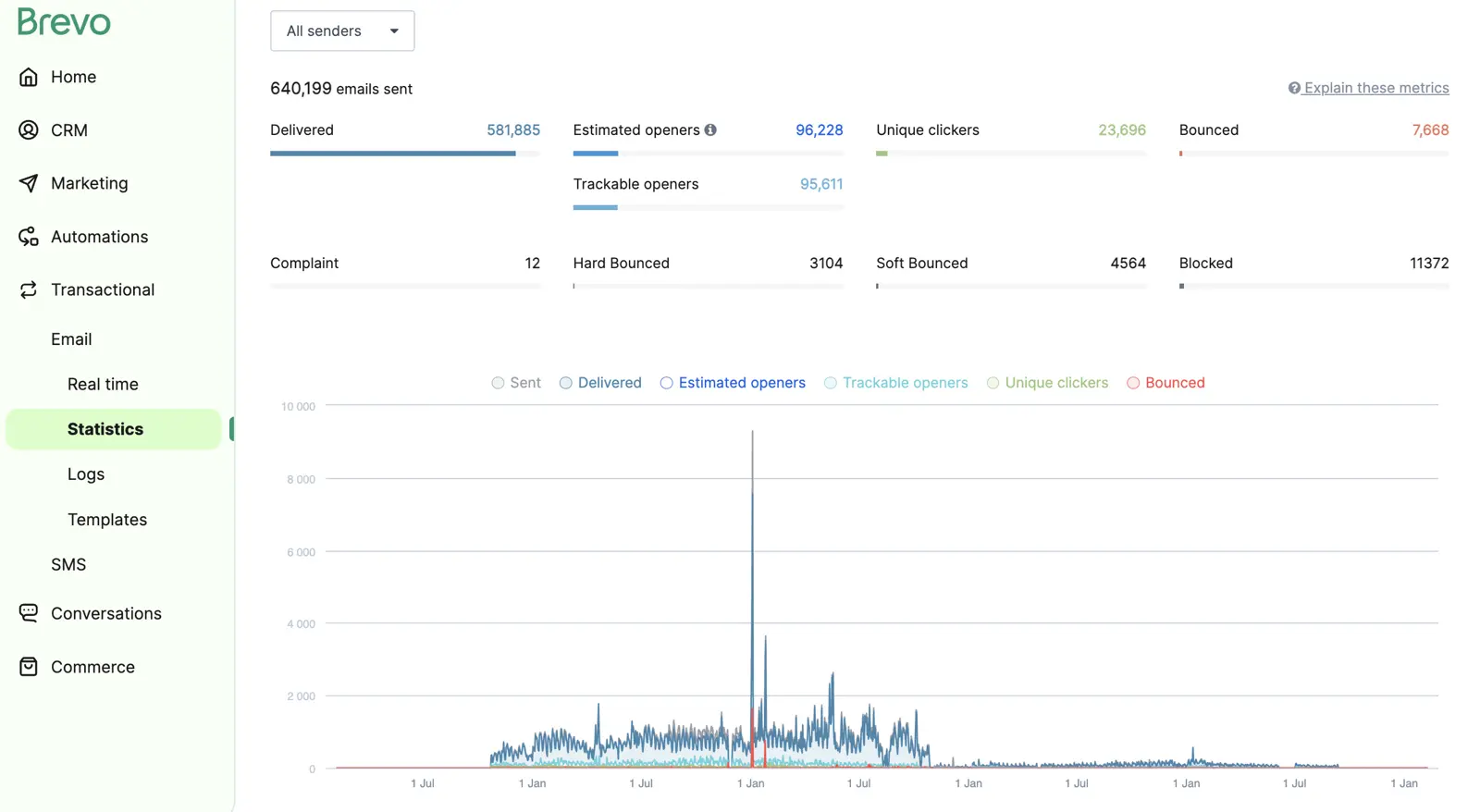
I’ve used Brevo since 2016, back when it was Sendinblue and primarily a transactional email service. Across our ventures, I’ve sent 640,199 emails through their platform without much drama.
It won’t win any awards for innovation, but it works.
Pros and Cons
-
Email-volume pricing is genuinely different: Unlimited contacts on every plan — including free — and only pay for what you send. 25K contacts emailing weekly costs ~$69/mo, versus $189-$300/mo on per-contact tools.
-
Generous free plan: 300 emails/day to unlimited contacts. A small business sending weekly to 2,000 subscribers pays nothing.
-
Straightforward automation: ActiveCampaign gives you more automation depth, but Brevo is considerably easier to learn. For welcome sequences and basic triggers, it does the job without the learning curve.
-
Transactional email included: Having transactional and marketing email in one platform simplifies your stack. Most competitors require a separate service.
-
Automation has a low ceiling: No split-testing automation paths, no predictive sending, no AI-generated workflows. Handles linear sequences well but lacks depth for sophisticated multi-path automations.
-
Account throttling complaints: Multiple Reddit users mention Brevo throttling speed or suspending accounts that spike in volume.
-
AI is minimal: Basic writing assistant and send-time optimisation on Business plan. Nothing that learns from your data or makes your marketing smarter.
Pricing
| Monthly Email Volume | Starter | Standard |
|---|---|---|
| Up to 9,000 (300/day) | $0 (Free) | — |
| 20,000 | $25/mo | $65/mo |
| 40,000 | $39/mo | $84/mo |
| 100,000 | $84/mo | $129/mo |
With 5,000 contacts sending weekly (20,000 emails/month), Brevo Starter costs $25/mo. ActiveCampaign Starter at 5,000 contacts costs $99/mo. That’s nearly 4x the price for the same basic use case.
The AI writing assistant is a basic content generator that doesn’t learn from your campaigns. Send-time optimisation is available on the Business plan ($65/mo+). I’d choose Brevo for simplicity and value rather than its AI features.
Is Brevo the right email marketing tool for you?
Small-to-medium businesses needing affordable email with basic automation. Particularly good for large contact lists with moderate sending frequency. Also the right choice if you need transactional and marketing email in one platform.
Open Brevo's WebsiteBusinesses needing advanced automation (go ActiveCampaign), eCommerce (go Omnisend), or CRM integration (go ActiveCampaign). Brevo is a useful middle ground, but if your needs extend beyond basic automations, you’ll outgrow it.
09Campaigner
Test Lab Partner (Paid)Campaigner is a member of our Test Lab Programme, which means we receive a fee to conduct hands-on testing of their platform. Learn more about our Test Lab Programme →Best email marketing software for SMBs wanting simple AI without complexity
Campaigner is the platform for businesses that want email plus a sensible AI layer — without the surrounding marketing-suite sprawl. It doesn’t try to be a CRM, a webinar host, or a workflow studio. It sends email well, has SMS as an add-on, and ships AI for subject lines and segmentation.
If you want straightforward AI-assisted email without a six-week onboarding, Campaigner is hard to beat. The automation ceiling is low and there’s no free plan to test on.
Pros and Cons
-
Audience Intelligence benchmarks against your own historical data, rather than a generic dataset. Subject lines and content suggestions are scored against your real campaign opens — a more relevant feedback loop than the generic LLM wrappers most competitors ship.
-
Strong deliverability infrastructure: Campaigner has been a deliverability-first ESP for 20+ years. Independent inbox-placement tests consistently put them in the top tier alongside ActiveCampaign.
-
The 30-day free trial includes full AI access. That’s generous compared to the 14-day trials most competitors offer, and the AI suite isn’t locked behind a higher plan.
-
SMS is available as an add-on. If you want a second channel later, you don’t need to switch tools or stitch in a separate provider.
-
No free plan. A 30-day trial is generous, but you can’t run a real business on it indefinitely. If $0 on the invoice is the deciding factor, look at Brevo or EmailOctopus.
-
The automation builder is limited, with basic branching, scoring, and conditional logic. Anyone with serious workflow ambitions will outgrow it within 12 months.
-
AI is a generation behind ActiveCampaign and Omnisend. It works, but it doesn’t learn from your account over time the way Active Intelligence does.
-
Reporting is plain, with no revenue attribution or advanced cohort analysis. Fine for SMBs sending newsletters — light for revenue-driven eCommerce or B2B teams.
Pricing
| Contacts | Starter | Essential | Advanced |
|---|---|---|---|
| 1,000 | $14/mo | $30/mo | $59/mo |
| 10,000 | $79/mo | $99/mo | $189/mo |
| 100,000 | $649/mo | Custom | Custom |
Annual billing typically saves 10-15%. The Starter plan includes the Audience Intelligence Tools — the AI isn’t paywalled behind a higher tier, which is rare in this category.
Audience Intelligence covers AI-generated subject lines benchmarked against your historical open rates, content suggestions written in your brand voice, and segment recommendations driven by engagement signals. It doesn’t learn from your account the way Active Intelligence does, but it’s a meaningful step above the generic ChatGPT wrappers most competitors ship.
Is Campaigner the right email marketing tool for you?
Small businesses and marketing teams who want straightforward AI-assisted email without a full marketing suite. If you’re sending newsletters, broadcasts, and simple automated sequences, Campaigner does the job cleanly. The gist: you care more about deliverability and useful AI than the deepest automation builder.
Open Campaigner's WebsiteeCommerce stores (use Omnisend) and B2B teams that need CRM-coupled automation (use ActiveCampaign). I’d also rule it out if you need conditional branching or split-testing whole workflows. Paying more than a free starter tool only makes sense if AI and deliverability matter to you from day one.
10Resend
Best email service for developers (API-first)
If you need email marketing triggered via an API, use Resend. It has a generous free tier — I don’t think I’ve ever actually paid for it, and I’ve used it across half a dozen micro-SaaS projects.

It’s remarkably easy to set up, particularly if you’re vibe coding a project in Lovable, Claude Code, or similar — most AI coding tools will just ask you for an API key and you’re all set.
Pros and Cons
-
Free tier covers real projects: 3,000 emails/month at zero cost. More than enough for most micro-SaaS projects and early-stage startups.
-
Setup takes minutes: add a domain, verify DNS, grab an API key, send. Documentation is clear, SDKs cover every major language.
-
Pro plan is absurdly cheap: $20/mo for 50,000 emails. Compare that to any marketing tool at the same volume.
-
No visual interface: No editor, no campaign builder, no automation, no landing pages, no forms. Everything happens through code.
-
Email infrastructure only: Resend is the plumbing that delivers emails your application triggers.
-
Younger company: Relatively young compared to established players — worth considering if long-term vendor stability matters.
Pricing
| Plan | Price | Emails/Month | Key Limits |
|---|---|---|---|
| Free | $0 | 3,000 (100/day) | 1 domain, 1-day log retention |
| Pro | $20/mo | 50,000 | Multiple domains, 3-day log retention |
| Scale | $90/mo | 100,000 | 7-day log retention, dedicated IPs |
| Enterprise | Custom | Custom | SLA, priority support, SSO |
None, and that’s deliberate. It’s a developer email API, so if you want AI in your workflow, you build it yourself.
Is Resend the right developer email tool for you?
Developers building applications that need to send email. Also the right choice if you’re vibe coding a side project and need email without the overhead of a marketing platform. If “npm install resend” means something to you, this is your tool.
Open Resend's WebsiteEveryone who isn’t a developer. There’s no visual interface, no templates, no drag-and-drop anything. For traditional email marketing, look at every other tool on this list.
The Best Email Marketing Tools by Type of Business
The best email marketing software for your business depends on what you do (and don’t) need. Here’s my take on the strongest contenders for different types of business.
Best email marketing software for eCommerce (Shopify, WooCommerce)
Winner: Omnisend. Runner-up: ActiveCampaign.
Omnisend was built from the ground up for eCommerce. The Shopify and WooCommerce integrations pull in your product catalogue, purchase history, and browsing behaviour so you can trigger abandoned cart flows and product recommendation emails that reference what each customer looked at. Revenue attribution is where Omnisend genuinely outperforms: you can see exactly which automation and subject line variant generated how much revenue. At $16/mo for 500 contacts, that's hard to argue with.
The omnichannel capability is what sets it apart. You can build a single automation that sends an email, waits 24 hours, fires a push notification if unopened, then follows up with an SMS — all within one visual workflow. I've tested this against cobbling together the same thing with separate tools and Zapier, and Omnisend's native approach is less buggy and faster to set up.
Why not Klaviyo? Their platform is very good – but doesn't justify the extra cost over Omnisend in my opinion. 10,000 contacts, Omnisend Standard runs ~$132/mo versus Klaviyo's $150+. Unless you need Klaviyo's deeper Shopify Plus integrations, Omnisend gives you more for less.
Best for B2B
Winner: ActiveCampaign.
B2B email lives or dies on what happens between the first signup and the sales call. ActiveCampaign handles that stretch better than anything else I've tested: lead scoring to separate tyre-kickers from buyers, site tracking to see which pages a lead keeps coming back to, and a workflow builder that can branch on almost any of it.
Its built-in CRM is fine for a small sales team. If you have a real pipeline, pair it with Salesforce or Pipedrive. ActiveCampaign's integrations with both are mature, so you keep your system of record and use ActiveCampaign as the marketing layer.
The alternative people ask about is HubSpot. Its native CRM-to-email attribution is genuinely good, but Marketing Hub Professional starts at $890/mo with onboarding fees on top. For established B2B companies doing £1M+, that can make sense. For most B2B teams under 25,000 contacts, ActiveCampaign gets you most of the way for a fraction of the cost.
Best for large businesses
Winner: Mailchimp. Runner-up: ActiveCampaign.
In a large business, the person building the email often isn't an email specialist. It's someone in product marketing, a regional team or the events team, sending a few campaigns a month. That's where Mailchimp earns its place: people across the business can ship good-looking campaigns without training.
Premium is the plan built for this. It adds advanced segmentation and priority support, and costs $1,025/mo at 100,000 contacts. That's not cheap, so it makes most sense when lots of people across the business are sending.
Choose ActiveCampaign instead if you're hooking into Salesforce or another established CRM. Its integrations with Salesforce, Microsoft Dynamics and Pipedrive are mature, so you keep your system of record and run complex, CRM-triggered automation on top. Mailchimp's automation is lighter, and that gap shows quickly at enterprise scale.
Best for startups
Winner: Campaigner. Runner-up: Brevo.
The startup question really comes down to one trade-off: pay a small bill from day one and get a real AI layer included, or stay $0 on the invoice and outgrow into a tool later. Campaigner and Brevo cover both ends of that.
Campaigner wins because it's the fastest path from "no account" to "first AI-assisted broadcast sent." The 30-day free trial gives you full access to Audience Intelligence — AI subject lines, content suggestions, and segment recommendations — so a non-technical co-founder can ship a campaign that performs above baseline without learning a workflow studio. When the trial ends, the Starter plan at $14/mo for 1,000 contacts is the cheapest serious email marketing bill you'll find with AI baked in. It's the "just get started, and start smart" pick.
Brevo is the runner-up and the better fit if staying on $0 indefinitely is non-negotiable — or if your startup has a transactional side as well as a marketing one (order confirmations, OTPs, password resets). Brevo prices by email volume rather than contacts, so you can have unlimited contacts on the free plan and send up to 300/day without paying. The Starter plan at $25/mo for 20,000 emails only kicks in once you've proven the channel. It also bundles SMS and WhatsApp natively — useful if you need multichannel from day one.
Both are designed to be outgrown. Once you pass 10k contacts and you're running real automations, see the Small business tab — that's where ActiveCampaign earns the upgrade.
Best for small businesses
Winner: ActiveCampaign. Runner-up: Sender.
Small businesses sit in an awkward middle: past the "free tier is fine" stage, but nowhere near the enterprise price tags. ActiveCampaign is where most SMBs doing real email marketing land — and once you're past 10,000 contacts with a few automations already running, it's the clear choice.
You get the visual automation builder (135+ triggers, conditional branches, split-testing), a built-in CRM with pipelines and lead scoring, contextual AI via Active Intelligence, and deliverability that consistently ranks in the top tier. At 10K contacts the Plus plan is $189/mo on annual billing. That's a step up from Brevo or Campaigner, but it buys back time on workflows that used to take days.
If the budget won't stretch that far, Sender is the runner-up. Its free plan covers 2,500 subscribers with automation included, and Standard is $69/mo at 10,000 on monthly billing. You give up CRM actions and depth, not the basics.
Just getting started? I'd go for Campaigner instead — see the Startups tab. ActiveCampaign is the right pick after you've validated email as a channel, not before.
Best for agencies
Winner: ActiveCampaign. Runner-up: Brevo.
Running email marketing for clients has a different set of requirements than running it for yourself: multi-account management, the ability to present a consistent brand across every client portal, and billing that scales with your roster rather than fighting it. Both ActiveCampaign and Brevo offer white-label / agency programs — which is why they top this list.
ActiveCampaign's Agency Partner Program gives you a centralised dashboard for managing all client accounts, margin on accounts you resell, co-branded or white-labelled login experiences depending on tier, and access to their partner support team. It's the tool most agencies I know already use for their own marketing, so reselling what you already know compounds the time saved.
Brevo's Agency plan is the runner-up and the better fit if your clients are small businesses on tight budgets. You get a sub-account hierarchy, white-labelled sending domains, and Brevo's send-volume pricing — which lets agencies manage a roster of clients without contract sizes ballooning as contact lists grow. SMS and WhatsApp channels are bundled too, which matters for agencies serving eCommerce or transactional-heavy clients.
Beyond these two, most platforms either don't offer white-label at all or bolt it on as an enterprise SKU at a price that defeats the purpose. Start with ActiveCampaign if your clients need automation depth; move to Brevo if your clients need volume at low cost.
Best for non-profits
Winner: Constant Contact.
Non-profits tend to share one awkward trait: the supporter list grows much faster than the number of emails they send. Years of event signups, donors and volunteers pile up, but the charity might only email everyone once a month.
Constant Contact's Starter Email plan fits that pattern unusually well. It costs $6/mo with unlimited contacts and a 2,500-send monthly cap, so the bill stays flat while the list keeps growing. Most per-contact tools would charge you for every one of those dormant supporters.
The editor was easy to use in my testing, and phone support answered in about a minute, which matters when the person sending the newsletter is a volunteer. The trade-off is the send cap: once you're emailing the whole list more than once a month, compare Constant Contact's Lite plan with Sender or EmailOctopus.
Best for creators
Winner: Beehiiv. Runner-up: EmailOctopus (if you're not monetising).
Beehiiv is built around the newsletter as a business. It takes 0% of subscription revenue on its paid plans, and the ad network, referral programme and cross-promotion between publications are all there to help the list pay for itself. It's free up to 2,500 subscribers.
Choose EmailOctopus if the newsletter isn't meant to earn yet. Its free plan covers 2,500 subscribers and 10,000 emails a month, and the builder was easy enough to hand to a less technical teammate. Design controls and automation actions are limited.
Best free email marketing software
Strictly speaking this isn't a type of business, but I know many of you are looking for an email marketing tool that's free (at least to start with).
Sender has the most complete free plan for a small business. 2,500 subscribers and 15,000 emails a month, with automation included, so you can run a welcome sequence alongside the newsletter. EmailOctopus is close behind at 2,500 subscribers and 10,000 emails. Both carry their own branding until you pay.
Brevo wins if you have a large list but send infrequently. You can have 50,000 contacts on the free plan and still send, as long as you stay under 300/day (~9,000 emails/mo). No other free plan offers unlimited contacts. The restriction is the daily cap, not the list — so Brevo is perfect for a monthly newsletter to a big list, and wrong for a weekly one.
Campaigner isn't free, but the 30-day full-access trial is the closest thing if you want AI from day one. Audience Intelligence (AI subject lines, content suggestions, segment recommendations) is included from the moment you sign in. After the trial, Starter is $14/mo — the cheapest serious AI-email bill on this list.
The 3 Big Email Marketing Names I’d Avoid in 2026
None of these three are bad tools, but across our testing I couldn’t find a situation where I’d pick one over the options above.
AWeber was my top recommendation in 2014. It’s still reliable, and their support is still human, which counts for something. Much of what it charges for is now free on Sender and Brevo.
Keap (formerly Infusionsoft) was in that original 2014 line-up too. It still puts CRM, pipeline and automation under one roof, and its onboarding programme is good. But the platform feels its age, the learning curve is steep, and pricing has crept above tools that do automation more elegantly. Several of our clients have moved to ActiveCampaign for exactly that reason (my Keap review has the detail).
Drip was my pick for small-to-medium eCommerce stores back in 2021. It’s still a capable eCommerce platform, but Omnisend now does the same job with email, SMS and push in one workflow, plus a free plan to start on.
If you’re already on one of these and it’s working for you, there’s no urgent reason to move. But if you’re choosing fresh in 2026, you can usually get more for the same money.
How to Choose Email Marketing Software in 2026
Choosing email marketing software shouldn’t take weeks. Most tools do 80% of the same things. There are nine real differentiators, starting with pricing and value for money.
1. Cost & Value for Money
Entry price is misleading. What matters is how costs scale as you grow:
| Tool | 1K Contacts | 10K Contacts | 100K Contacts | Scaling Factor |
|---|---|---|---|---|
| Beehiiv | $0 (free) | $139/mo (Lite) | $469/mo (Lite) | 8x (Lite, 1K to 100K) |
| Brevo | $0 (free)* | $35/mo* | Custom* | Volume-based |
| Campaigner | $14/mo | $79/mo | $649/mo | 46x |
| Constant Contact | $6/mo | $6/mo* | $6/mo* | Flat Starter tier |
| EmailOctopus | $13.50/mo | $44.50/mo | $345/mo | 26x |
| Sender | $15/mo | $69/mo | $389/mo | 26x |
| Mailchimp | $26.50/mo | $110/mo | $800/mo (Standard) | 30x |
| Omnisend | $16/mo | $132/mo | Custom | 8x+ (to 10K) |
| ActiveCampaign | $15/mo | $149/mo | $1,199/mo | 80x |
* Brevo prices by email volume, not contacts. Constant Contact Starter Email stays flat, but only includes 2,500 sends per month. ActiveCampaign prices are on annual billing; Beehiiv, Mailchimp, Sender and EmailOctopus are month to month.
ActiveCampaign and Campaigner are nearly identical at entry — $15/mo vs $14/mo for 1K contacts. At 10K, ActiveCampaign is $149/mo vs Campaigner’s $79/mo — nearly 2x more, but with vastly deeper automation. At 100K, ActiveCampaign is $1,199/mo vs Campaigner’s $649/mo — under 2x more, but with the workflow depth Campaigner simply can’t match. If you need serious automation, the premium is justified. If you mostly need broadcasts plus a sensible AI layer, Campaigner scales more predictably.
The budget picks: At 100K contacts, EmailOctopus ($345/mo) and Sender ($389/mo) cost about a third of ActiveCampaign Starter. You give up automation depth, but if you mostly send newsletters, that’s money you keep.
2. Ease of Use
The simplest tools are Mailchimp and Campaigner. Mailchimp’s builder needed the least thought of anything I tested, and its templates look good before you change a thing. Campaigner shortens the curve further with AI subject lines and segment suggestions out of the box.
The most complex is ActiveCampaign, simply because there’s so much of it. The flowchart-style canvas makes that depth easier to learn than you’d expect, but budget a weekend.
3. Deliverability
In my Mail Tester checks, ActiveCampaign and Sender scored 9.5/10, and Constant Contact and Mailchimp scored 9/10. But deliverability depends more on your sending behaviour than on which platform you use. List hygiene, engagement rates, and authentication setup matter more than which servers your emails pass through.
4. Features
ActiveCampaign has the deepest feature set for automation. Omnisend has the most for eCommerce, with email, SMS and push in a single workflow. Sender packs the most into a free plan.
The number of features matters far less than whether you’ll actually use them. Most businesses use under 20% of what their tool can do.
5. CRM & Automation
ActiveCampaign’s workflow builder is in a league of its own: 135+ triggers, conditional branching, split-testing entire paths. Sender and EmailOctopus both handled my welcome-sequence test with delays and conditions, but neither offers native actions in third-party apps. If your CRM runs the business, that gap matters.
6. Reporting & Analytics
For eCommerce: Omnisend’s revenue attribution is the most granular. For small teams: Mailchimp’s Analytics AI summarises campaign performance in plain English. For everyone else: ActiveCampaign offers solid analytics with engagement scoring.
7. Integrations
Most tools integrate with major platforms. Omnisend’s Shopify integration is deepest for eCommerce. ActiveCampaign has the broadest library, with 1,000+ integrations and the most Zapier triggers/actions.
8. Support & Training
ActiveCampaign and Omnisend offer 24/7 live chat on paid plans. Campaigner has phone, email, and live chat support across all paid tiers — unusual for a tool at its price point and a reflection of their deliverability-first heritage. In my own support tests, EmailOctopus put me through to a human on live chat in about 40 seconds, and Mailchimp’s chat agent spotted the false premise in my billing question and fixed it.
9. Security & Compliance
In 2026, this isn’t optional. GDPR enforcement is intensifying and US state privacy laws are multiplying (nearly 20 states with active legislation). All reputable tools support GDPR compliance — check for Data Processing Agreements, consent management, and right-to-deletion workflows.
AI Features Worth Paying For in 2026
Every email marketing tool now claims “AI features.” Most are being generous with the definition.
Most tools offer the same AI text generator you could use for free on ChatGPT.com. The output is the same whether you’ve used the platform for one day or five years. This describes the AI in Brevo, Constant Contact and Beehiiv. Handy for writer’s block, but not a strategic advantage.
A few tools apply AI to their specific domain. Campaigner’s Audience Intelligence benchmarks subject lines and content against your own historical open rates rather than a generic dataset — a meaningful step above a plain ChatGPT wrapper, though it doesn’t persist or compound the way Active Intelligence does. Omnisend’s AI understands your product catalogue. Sender and Mailchimp both connect to Claude: in my tests, Claude built a draft welcome sequence inside Sender, and turned a campaign plan into Mailchimp drafts.
Only ActiveCampaign offers genuine contextual intelligence. Active Intelligence builds a persistent model of your brand voice, engagement patterns, and performance history. It genuinely gets smarter over time. This is the only best-in-class AI we found in the comparison.
The question to ask: does the AI get better the longer I use the platform? If yes, it’s worth paying for. If no, it’s a convenience feature.
The only way to know whether contextual AI justifies the price for your list is to run it against your own campaigns — ActiveCampaign’s 14-day trial is long enough to find out.
Email Marketing Software Pricing Comparison
Full pricing breakdown across all 10 tools at key contact tiers:
| Tool | Model | 1K | 10K | 100K |
|---|---|---|---|---|
| Beehiiv | Per subscriber tier | $0 | $139 (Lite) | $469 (Lite) |
| Resend | API volume | $0 | $20 | Custom |
| Brevo | Per email | $0* | $35* | Custom* |
| Constant Contact | Starter sends | $6 | $6** | $6** |
| EmailOctopus | Per subscriber | $13.50 | $44.50 | $345 |
| Sender | Per subscriber | $15 | $69 | $389 |
| Campaigner | Per contact | $14 | $79 | $649 |
| Mailchimp | Per contact | $26.50 | $110 | $800 (Standard) |
| Omnisend | Per contact | $16 | $132 | Custom |
| ActiveCampaign | Per contact | $15 | $149 | $1,199 |
* Brevo: estimated at 4 emails/contact/month. ** Constant Contact Starter Email includes 2,500 total sends per month.
All prices shown are entry-tier rates. I rechecked the top six and Beehiiv in October 2026 (ActiveCampaign on annual billing, the rest month to month); the others date from July 2026. Visit individual pricing pages to confirm.
Final words
Don’t overthink it. Most email marketing tools do 80% of the same things. The real differentiators — automation depth, pricing model, domain-specific features — only matter if your business specifically needs them.
If you’re just starting out, pick Constant Contact ($6/mo) if you send fewer than 2,500 emails a month, or Campaigner ($14/mo with a 30-day full-access trial) if you want simple AI help from day one. If you’d rather not pay anything until the list is worth it, Sender’s free plan covers 2,500 subscribers. You can always migrate later. The tool matters less than the habit of sending regularly.
If you’re scaling and need automation, ActiveCampaign is the answer 8 times out of 10. The 2 exceptions are pure eCommerce (Omnisend) and teams where lots of non-specialists build the emails (Mailchimp).
The worst decision is spending three weeks evaluating tools instead of writing emails. The second worst is choosing a tool because of its brand name rather than testing whether it fits your needs.
Just start sending. Getting into a rhythm matters more than which logo is on the dashboard.
If you want to see the raw data behind these rankings — including the scoring criteria, weightings, and how each tool performed — I’ve published the full dataset: Email Marketing Software Ranking Data (Coda).
93 Reader Comments
The data set file is not being sent. Could you please send it to me? Thanks! I'm very interested as I'm selecting a marketing automation tool right now. Thanks.
Hi Marcus, thank you for the research, very much appreciated. I'd also appreciate the data set you offered to share if the offer still stands. Thanks again!
Great and informative post. Where is the download / raw data "at the bottom" - I must have missed the link
Hi Marcus
This is a very informative topic... Thank you for sharing with us.
I recently switched from MailChimp to Mailerlite and have been pleased with the results. I ran into a small problem and the customer service was excellent and responded very quickly (I’m using the free plan).
Hey,
thanks a lot for creating such a detailed and objective overview of the email marketing providers!
I would really like to have a look at your dataset, I already filled out the survey twice, but it does not seem to work - still no email with dataset received. Could you please send it to me? Thanks a lot!
Kind regards,
Maria
Great article.
Just wanted to point out that there is an error in SendX's pricing in the Pricing Comparison table.
SendX's pricing is close to $100/mo for 10,000 users.
On the SendX website, the pricing is mentioned in slabs - so the final bill will be the addition of all slabs that are applicable to your number of contacts.
Thanks for raising this Rajesh, we've updated our dataset to reflect this.
Hello Marcus Taylor,
Thank you to share such a piece of useful information with us. keep posting such kind of Information.
???? will do!
Thanks for this informative review Marcus. What are your thoughts on ConvertKit? It was recommended to me, I am a blogger who does it for passion for the last 5 years, but I am thinking of starting to monetize my work.
It's perfect for bloggers, but I wouldn't recommend it for any other use case.
Thanks for putting this together, my head was spinning from trying to figure out who/what to use.
Please forgive me if I missed this in some of the comments and replies, but I saw nothing on Infusionsoft or Marketo. I was expecting to see both in your analysis, but nothing was mentioned, save for the remark early on that Active Campaign has rocketed past Infusionsoft in the marketplace. Is it because you consider them outside the "Email Marketing" space which was the subject of your analysis?
Thanks
Hi Paul, back in 2015/2016 both Marketo and Infusionsoft made our top 10, but they've gradually been slipping each year.
Keap (formerly Infusionsoft) is now in #37th place and Marketo is at #78th. There's nothing wrong with these platforms, but they just don't score as highly in the nine areas that we believe (from interviewing email marketing users) are most important.
We also observe from migration data that a large number of Infusionsoft users end up moving to other email marketing services, citing 'difficult to use' as a common reason, so I'm somewhat reluctant to recommend their platform these days.
SENDLANE IS A HORRIBLE TOOL. Used this for a month then switched to Klaviyo and it is light years better. Sendlane had a million bugs and almost ruined my business.
Hi Jason,
Ouch! We've added this feedback to our dataset. Incidentally, we've seen some similar signs on our end. They've fallen to #14 on our list this year so won't be making the 2020 top 10.
Thanks for sharing ????
Hi Marcus
This is very informative post for us. Thank you for sharing with us.
Thanks for this article. It is super helpful. I have used quite a few different ESPs (Bronto, MailChimp, Constant Contact, dotmailer, Listrak and now Informz) and have my opinions about all of them. But I have always worked for e-commerce companies. I now work for a non-profit association and we need an ESP that integrates with our database, which is run on Aptify. The only ESP I have found that claims to integrate with Aptify is Informz (Higher Logic) and lets just say, the integration doesn't actually work and the platform itself leaves a lot to be desired. So I was wondering if you knew of any other platform that might integrate with Aptify or be able to build an integration?
Wow, you've tried them all!
It seems it may be a bit of an issue on the Aptify end, as they don't seem to offer much in the way of an API from what I can see, so it's probably a challenge for ESPs to integrate with them.
The only two options I can see from a quick browse is Higher Logic (as you mentioned) and a company called HighRoad, though I'm not familiar with either.
Powerful review!
What options are available for sending cold email?
Mailshake and Woodpecker.co are both worth a look.
Fantastic article, thank you! I was wondering if I could ask some advice -- we are only a small company that doesn't need automation or a CRM, we just want to be able to send out monthly emails to 6000 subscribers that can be categorised into industries or groups. We don't need bells & whistles. Due to our industry, the chunky CRM doesn't integrate into a.n.y.t.h.i.n.g. so it's all very labour intensive but lucky for them I do love a spreadsheet. Thanks in advance for the advice.
Hi Bec,
I would probably look at something like MailerLite or Moosend. They're both very affordable and do the basics very well (while taking care of the dull, but important stuff like security & deliverability).
While they do both offer automation, you can obviously just use them for basic mass email sending - and both should be affordable at 6,000 contacts.
Marcus, thank you very much for detailed yet to the point review! I am looking for the email program for our small activity which we are planning to grow fast. You saved me tones of time and money on trials and errors. Mailchimp is a bit outdated. So I am looking forward to our new adventure and hope to continue with the program for many years.
Why are some of the comments from 2014? Is this an old article or is it updated with the latest and greatest options?
Hi RDH,
This article was first published back in 2014 and has been updated (at least) every year since.
This was the most helpful article ever. After all the tests, I think that I'll go for ActiveCampaign. Thank's!
HI Marcus
Found your article very informative especially as I am a novice in all this. We are about to launch a research centre in the UK and wondered which email marketing tool you would recommend. Having read quite a bit now online, I see a lot of the literature seems to concentrate on business users rather than non-profits. Any suggestions would be most welcome.
Many Thanks
Hi Anna,
I would take a look at Moosend, who offer a 25% discount to non-profits. If you need something a bit more powerful, ActiveCampaign offer a 20% discount.
Hi Marcus,
Thank you for this detailed report. One of the options I am considering is Drip, it seems to be popular. Did you consider it?
Any thoughts on Drip vs ActiveCampaign?
All the best,
Jim
Hi Jim, yes - we did consider Drip.
This year Drip came out in 31st place in our ranking of the top 100 email marketing services. One factor pulling down their ranking was a high number of Drip users moving away from their platform reporting four issues in particular as the reason: Integrations, low-quality support, bugs, and difficult-to-use UX.
Hope that's useful.
A very thorough and well-written blog on Email Marketing software tools. These are some very decent tools which will prove helpful for novices like us. Thanks for the blog Marcus.
Hi Marcus,
Thanks for the review.
It looks like it's been a while since the review has been written 4 years ago (according to the most of the comments above).
Please advice on how it's relevant up to date?
We are looking for a mail marketing tool for b2b software services company.
Would appreciate your feedback.
Thanks!
Oleg
Hey Oleg,
We've just posted our 2018 update! A few new tools have made the cut, and a couple of old ones removed. All of the data has been updated as of October 2018, so that should be useful.
For B2B software, I'd probably look at either Hubspot/ActiveCampaign? We use ActiveCampaign as our email marketing tool for Leadformly, which is a B2B SaaS service.
Marcus
A very useful post, thanks Marcus!
I’ve had used email services from different service providers in the past for my own online business although now I have moved to Benchmark Email and using there services.
I found almost every service providers relatively easy to use but almost everyone lacks in providing support to there client and now-day's support is like backbone of any service.
Benchmark Email provide chat & call support apart from email support and that to 24*7 and because of limitless support from Benchmark Email I am sticking with them.
I've often seen Mailchimp is lacking in showing Popups (I really don't care about those who don't prefer Pop Ups).
One more thing I want to add that Mailchimp's Workflow is not as effective as Getresponse have.
I have reviewed both of the services for myself and found Getresponse much better than Mailchimp and even from others too (Cost effective).
such a great article...thanks a lot ..... it help me alot
Hi Marcus..
Thanks so much for these summary articles. I'm teetering on the edge of a blog and was sooo confused until I found this and your other articles on the topics needed to establish my site.
Your info is presented in clear and informative manner.. When I launch I'd like to refer readers to your articles.. Is that okay?
Of course! :)
Also interested if you'd have any comments on Drip?
Thanks!
I hear lots of good things, but (and I may be going crazy) I recall Drip offering a $1 signup offer when they were acquired by Leadpages and so a lot of people were commenting on how good it was for a dollar. It seems to have gone back to the old pricing and repositioned slightly to eCommerce email marketing. I'm sure it's an excellent product.
Thanks for the article Marcus. We have about 25000 subscribers and currently use Mail Chimp. We're looking to change though, for three reasons - we'd like to integrate with a CRM, want to send smarter, automated emails and gather customer activity data, would like a service with actual customer support.
Mailchimp advertises that they do automation etc, but I can't seem to find where to set up anything very smart. Also their customer support is non-existent. Seems impossible to contact a human.
Do you know if mailchimp actually does offer what we're looking for, or we're better to move to something like active campaign? Appreciate your comments ;)
Hey Karlie,
I haven't used Mailchimp for many years as they just don't seem to have kept up (particularly around marketing automation), but technically I think the answer is yes - they can do what you're after.
However, I guess the real question is whether they're the optimal solution to do what you're after, in which case the answer is likely no. We've just updated this guide with some more up-to-date comparisons, which hopefully should answer your question!
Excellent article. The best and non-bias review I've read about email marketing software thus far.
I've been shopping around and will probably go with Get Response. Initially I was looking at Mail Chimp since they had the 2000 free subscribers but it appears, in the longer run, it'll be better with GetResponse.
Haven't used email marketing as much as I should. Previously, we tried using ImnicaMail because of their pricing but it was as good as not having an email marketing campaign; all our mail was sent to spam (since they did not manage their customers' list for spam). Thought email marketing wasn't effective until I found out our emails were being sent to the spam box. Learnt my lesson there.
Thanks again for the useful article.
Thanks Benjamin! Sounds like a good choice after your bad experience - I'd love to hear how you're getting on with GetResponse.
Marcus
Wow such a detailed review! I have tried MailChimp before and I found it too expensive. After that i've signed up to Mailerlite and got hooked. It's either free or cheapish depending on your subscribers' lists. With other email software providers, you'd need to make an investment even if you're running a small shop or a blog. And let's be honest, not everyone of us can afford it :)
Yep, we moved away from Mailchimp for the same reason :) hope it's all going well
I'm shopping to upgrade my email marketing software. Just got off the phone with Constant Contact. Can't believe they don't offer A/B testing!
I have a database of 2000 emails that I have marketed to for some time now from a pop 3 email without using a service.
I imported it to mail chimp and it wants a double opt in. How can I bypass that.
Once I start using mailchimp then people can easily unsubscribe if they don't want the email.
If you want cheap, easy and something you can grow with, I recommend MailChimp. You can even start out free with them. Later, if you decide to change platforms, it’s relatively easy to transfer your list.
Thank Marcus, the summary was a great help.
Great review Marcus! Have you looked into contactpigeon.com? They are a new e-mail marketing platform that offers data driven campaigns with thorough segmentation and automation features.
Hi I am new to direct email marketing. Sendy looks like a good pick based on this post. Thanks, Marcus for this article.
Just a question, is it possible to export back only the delivered emails back to our database or via a .csv file.
Hi Marcus,
Thanks for the article, it was also interesting and inspiring to see your other ventures in diverse fields. Would like to connect 1:1 in the near future. Meanwhile, even I had done a similar comparison as I myself handle email marketing for my organization. Do check it out as well as for the readers of the blog since it covers 2 additional players.
Cheers,
Karan
Hi Karenpreet, you're welcome.
I took a look at your comparison - good work. More than happy to connect anytime if you want to drop me an email.
Marcus
@Frank - I've never heard of them, and a quick Google search for your name MPZ Mail reveals you promoting them on Quora. I'm not sure why you'd ask for more information on them if you're already a user recommending them to others? Are you affiliated with them by any chance?
I really enjoyed this article but could anyone tell me a little bit more about MPZMail? It's not on this list, however I know a fair few people who are moving from MailChimp. I've had a look around and it seems to be pretty good.
Great post Marcus,
I've always been a mailchimp user myself, and I have to say I really like their UI but I'm always open to new options. I've dabbled in a couple of the other email marketing providers like Pure360 - but find them so clunky and annoying to use (despite them looking really pretty and having great templates) that I always end up going back to good old mailchimp. I haven't used GetResponse yet, I'll give their free trial a shot :)
Thanks Kelly, Mailchimp have definitely come a long way with their UI over the years, it's just their service that hasn't caught up ;) I haven't had the chance to play around with Pure360 as much as I'd like, but I've heard the same things echoed by several friends who use their service. Looking at their client list, I think they're more aimed at large companies though.
Fantastic article Marcus. Really enjoyed this detailed post.
After reading this I think I will move to and try out Ontraport!
Nathan
Thanks Nathan, Ontraport's awesome :)
I'm currently looking for a hosted email marketing service that offers SMS services and integrates with Salesforce. We have a customer database of over 250,000 users and need to be able to send them SMS messages as well as emails at roughly the same time as appointment reminders.
I've spent a long time looking at the different options, and there doesn't seem to be anything exactly what we're looking for (without requesting customisation), but before I give up hope I wondered whether you knew of anything?
Hi David,
Check out Pure360 - from their website it seems like they have both SMS services and integration with Salesforce. I can't vouch for their service as I've never used it, although I did used to live about two minutes from their offices in Brighton! The other option would be something like Infusionsoft. I'm pretty certain that they have SMS functionality, and would be very surprised if they didn't integrate with Salesforce.
Hope that helps.
Marcus
This is so helpful! We've been using an old school bespoke email program at our company for years and have finally come to the realisation that we need to enter the 21st century!
One question - do you know how easy it would be to connect a tool like Aweber or GetResponse to a customer database? We would hate to lose our list of customer data during the move, so that's a big concern for us.
Thanks Nina, sounds like a much needed upgrade ;)
Do you know whether your current email service allows you to export subscribers? If so you should be fine. All of the email marketing tools reviewed in this post allow you to import subscribers from a CSV file, so providing you can get all of your existing subscribers into a spreadsheet you'll be absolutely fine.
Marcus
I think so. I'd need to take a closer look but I'm sure you're right.
Thanks for the help!
Nina
Great review Marcus!
I'm currently looking for an email marketing service for a mailing list of about 80,000 subscribers. I run an information product business in the fitness industry with a large number of customers buying our ebooks and online courses every day. I'm particularly interested in GetResponse, although I'd be keen to hear your thoughts on the flexibility of their service for creating autoresponders, and integrating with a checkout service (we use WooCommerce).
I see that you've recommended Infusionsoft, which I was also looking at. Do you have any strong opinions on which one would be better for our kind of business?
Hi Peter,
It really depends on your budget and how much automation you need.
GetResponse would be a great pick, although their automation is quite limited at the moment. For example, you can setup standard autoresponders, and autoresponders based on behaviour such as "opened previous email", but it's very hard to separate customers from non-customers etc.
With Infusionsoft (or other marketing automation alternatives like Ontraport, Marketo, Pardot), you'd have a lot more flexibility with automation, but that may be overkill depending on what you're looking to do.
The main thing to consider is that Infusionsoft starts at $199/month a one-off $2,000 fee for a kickstarter package. Realistically, you'll likely end up paying $300-$400 per month for one of their more advanced packages. GetResponse is $450/month for 100,000 subscribers.
In terms of integration with Woocommerce, i'm pretty sure you'd have more luck with Infusionsoft. It looks like they have a plugin called 'InfusedWoo' in their app marketplace here: https://marketplace.infusionsoft.com/app/infusedwoo
Hope that helps,
Marcus
It sounds like Infusionsoft is probably the direction we need to head in. If it's more affordable than GetResponse and has better automation, then it's a bit of a no brainer.
While we don't need full blown automation, it's important for us to be able to send different campaigns to customers based on whether they have/haven't bought certain other products. Based on what you've said, and what I gather from their website, this seems out of GetResponse's depth.
Thanks Marcus, I appreciate the advice.
Highly descriptive article. Will there be a part 2?
Thanks Maura - I don't think so. If anything changes I'll most likely just update this post.
Really good information, thanks for the comparison Marcus!
Anytime :)
Great timing, Marcus. I signed up for free trials with Mailchimp, GetResponse and Aweber about a week ago and was just doing some research to confirm my thoughts.
I agree with you that overall GetResponse are the best of the bunch. However, I did find that Mailchimp's UI was way better and easier to use. It's just a shame that they force you to jump through hoops with double opt-ins, and their payment structure was a little bit off putting.
What I'd like to know is whether any email marketing software provider allows you send emails that look identical to if they were sent from Gmail. I find that the best newsletters are those that look like it came from a friend. If only Mailchimp or Aweber didn't force their logos and HTML style in every campaign I imagine they'd get way better open and click through rates. Do you know of any services that do this?
Hi Kevin,
It sounds like you're after plain-text email campaigns, which all of the services reviewed above offer as standard. Instead of creating a HTML campaign, you should be able to select plain-text from a drop down menu and go from there. That should disable all of the logos, and formatting that give emails the 'newsletter template' look.
Marcus
Marcus,
Thank you for this article, it's been a great help for our company while we're in the process of moving to a different ESP.
I wondered, what are your thoughts on solutions like Mailigen, Vertical Response, Mad Mimi, and Campaign Monitor? I know there's a never ending list of possible email software companies that you could compare, but these ones in particular interested me as they seem to offer many similar services to those that you mentioned. Have you come across them before, and if so would you advise using them over GetResponse?
Another question I had was to do with email delivery rates. Do you know of any way to gauge the quality of an email marketing software company's delivery rates before becoming a customer and running your own test? I'd love to see a comparison like this post focusing on quantitative metrics like that. Perhaps an idea for a future post?
James
Hi James,
I've heard of several of the providers you mentioned, but I haven't used them on any projects so I can't really comment. From a quick browse of their websites they all look fine, but nothing jumps out at me in terms of a unique proposition.
In terms of delivery rates, I know there are websites like SenderScore, which provide some information on delivery rates, but it's good to remember that those numbers are never static. If a company like Infusionsoft upgraded their servers, or changed the IP address that they send mail from, the stats would immediately become outdated.
Similarly, it's probably worth taking any numbers provided by the email services with a pinch of salt, as they're more than likely to be a little bit on the generous end of the spectrum.
In my experience, it's not something you really need to worry about unless you're sending 100,000's of emails per month, as the difference it makes is very minimal.
Hope that helps,
Marcus
Let's keep in mind that these are all different cases:
- Desktop-based email marketing software (installed on your personal computer).
- Serviced model or Saas (like MailChimp and others presented here).
- Self-hosted (installed on your own server like Email Marketer and nuevoMailer).
- Hybrid: self-hosted using 3rd party SMTP relay services (quite trendy lately).
There is no one-size-fits-all solution. Each model has pros and cons.
Low-mid volume, occasional senders and not so technically literate users will probably do better with the serviced model (or a desktop based solution).
Medium to heavy users are more likely to go for a self-hosted solution and usually the hybrid approach.
Hi Panos,
That's a good breakdown of the different types of email services. I aimed this post at the large majority of people who would just be looking for a Saas service like Aweber or GetResponse, but you're right that there are many alternatives.
I have very few mail customers but would like to get started on this. If I use mail chimp to get my first 2000 email addresses over the next year or so ( obviously for free! ) can I then migrate them into Get Response when I am ready to start paying a monthly fee? I am a musician so it is more for my fans than for selling.
Of course - I did a similar thing when I was building the newsletter for TheMusiciansGuide.co.uk. It's relatively easy to export and import between the various email marketing services, so you should be fine.
Have you looked into Radio Airplay or FanDistro? They're both really good tools for collecting the email addresses of fans that like your music. I remember reading a case study that Brian Hazard of Passive Promotion / Color Theory wrote where he got thousands of fan email addresses using Radio Airplay.
Thank you, You just gave me a very cool tip! Great article, I will look up The MusiciansGuide too!
I dug Aweber and getresponse when I used them. Smart post Marcus! Now I use my gifting club's email service, and have moved a bit away from email marketing. But overall helpful read here and a must for most marketers.
You're welcome, thanks for commenting Ryan!
Cheers Ben, i've corrected this. I didn't come across either when I was playing around with Sendy - must not have been looking hard enough!
Being Sendy users ourselves, we were also little bit disappointed with the limited reporting options offered by the app. So we built an extension which will help you to build dashboards, per-list reports, calculate conversions, etc.
Really well written post Marcus!
It'd be great to hear what some of the email marketing software providers have to say in response to this review and what *they* consider to be their strengths over the competition.
Out of interest have you come across SendBlaster or Vertical Response? My company trialed SendBlaster a while back and I remember being quite impressed with the overall ease of use. Vertical Response was the other one we looked at which we'd heard good things about but ended up not going with for some reason or another.
Would love to hear your thoughts on them if you've come across them before.
Thanks Jason
I agree, it'd be great to hear from some of the guys in the space to know what differentiates them in their view.
As for SendBlaster and Vertical Response, I've definitely come across VR in the past but not sure about SendBlaster. The name rings a bell but I can't think where from, and from their website it doesn't look like one that i've used.
Vertical Response looks interesting - although again I can't quite figure out what really separates them from the other more popular services.
A very useful summary, thanks Marcus.
I've had some success using Mailchimp in the past although eager now to try others services.
I found MC relatively easy to use and navigate once I understood some of the terms
relating to (all) mailing lists such as auto-responders, lists, groups, A/B testing.
One positive for mailchimp is I found their guides/tutorials very good.
I'm in the process of expanding and evaluating services such as Aweber on another site and interested in other providers too.
Two questions:
1. With any of these services are you able to manage multiple sites/lists of subscribers under one account, even if those lists/subscribers/topics are unrelated?
2. Any thoughts on Feedblitz as I see people starting to use that service now too?
Thanks for the very insightful evaluation.
Thanks Rob!
Mailchimp are pretty good - probably one of the most intuitive services to use. The main disadvantage is their double opt-in, which results in losing ~20-30% of people who go to sign up to your mailing list but don't confirm in the email.
I'm pretty sure that all of the services reviewed let you manage multiple sites under one account. Aweber, Mailchimp, Sendy, and Get Response definitely.
I haven't heard of Feedblitz - just looking at their website now. Appears that they're a Feedburner replacement specialising in RSS-to-email (sending your blog subscribers an email about latest posts). Their pricing looks a bit steep (considering Feedburner was free) - so I'd probably choose Mailchimp or Aweber over them? That way you can message up to a few thousand people free of charge.
Hope that helps!
Hey Marcus,
George from Sendicate here. We're an email newsletter web app that aims to fix the current complex on boarding and newsletter sending process. We also allow single-opt in on lists if ya want :) Got RSS to email and all the bells and whistles too, we just try and make the user flows simple. Check us out.
Cheers,
George